Who Owns Scotland 2025
SCOTLAND’S CONCENTRATED PATTERN OF LANDOWNERSHIP CONTINUES TO GET WORSE
Today I publish Who Owns Scotland 2025, the second annual report on landownership in Scotland. The first (Who Owns Scotland 2024) was published in March 2025.
In addition to a high level analysis of who owns Scotland, how much they own, the types of legal structures involved and the top 25 landowners in 2025. The report also also tracks the pattern of landownership over time. This blog is merely a brief signpost to the report whose key finding is the now well established trend of fewer and fewer owners owning more and more of Scotland.
Read it here.
It is only 16 pages long.
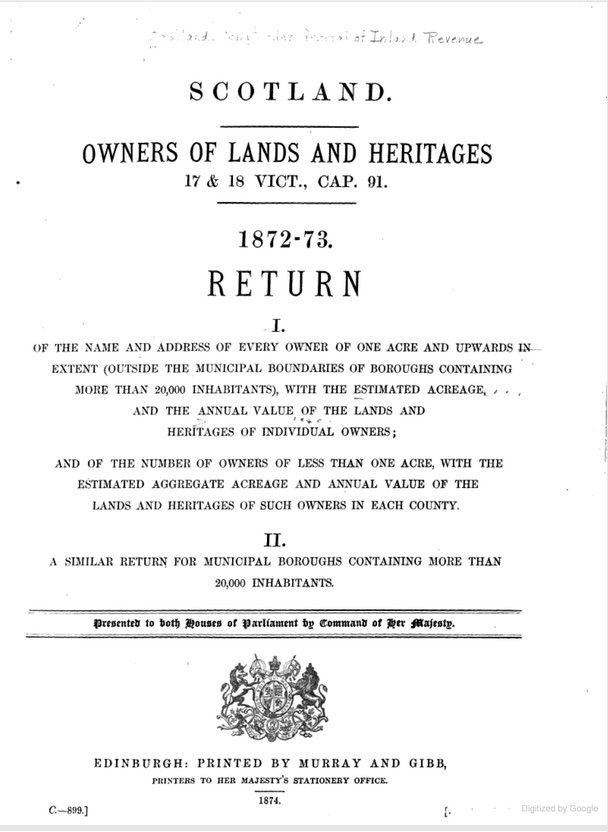
The first good statistical record we have of landownership was published in 1874 by the government. The Return of Owners of Lands and Heritages Scotland 1872-1873 provided an account of the names and addresses of proprietors of land outside burghs of over 20,000 population.
The second data point is 1970 when an Aberdeen University geographer, Dr Roger Millman published The Proprietary Survey of Scotland. the exercises was funded by the Countryside Commission for Scotland, the Highlands and Islands Development Board, the Scottish Landowners’ Federation and two academic funders. The data and maps from this study were later deposited in the National Archives of Scotland and formed the basis of John McEwen’s book, Who Owns Scotland first published in 1979.
Then in 1996 I published my own book of the same name and have been monitoring the changing pattern of landownership since then with the basic information published on my Who Owns Scotland website.
I now know the ownership of just under 77% of rural Scotland and the pattern (though not the ownership) of a further 5%. The report I publish today contains the analysis of 7872 records abstracted from my database as at 31 December 2025.
At a high level, the pattern remains little changed from the past 50 or more years with 83% of rural land held by private entities, 11.3% by public bodies such as Scottish Ministers and Scottish Natural Heritage, and the remainder by not-for-profit groups such as community bodies and environmental and educational organisations.
The core distinguishing element in Scotland’s pattern of landownership has always been the very concentrated pattern of ownership by a small number of owners. This stands in stark contrast to the rest of Europe. This contrast is mainly explained by Scotland’s law of inheritance whereby children have no legal right to inheritance land. Across Europe by contrast, children do have such a right and so over the past 250 years or so, large holdings have been split up in to much smaller ones as each generation inherits the land. This has, in turn led to a strong co-operative culture in the Nordics, France and elsewhere whereby small landowners have established powerful co-operatives.
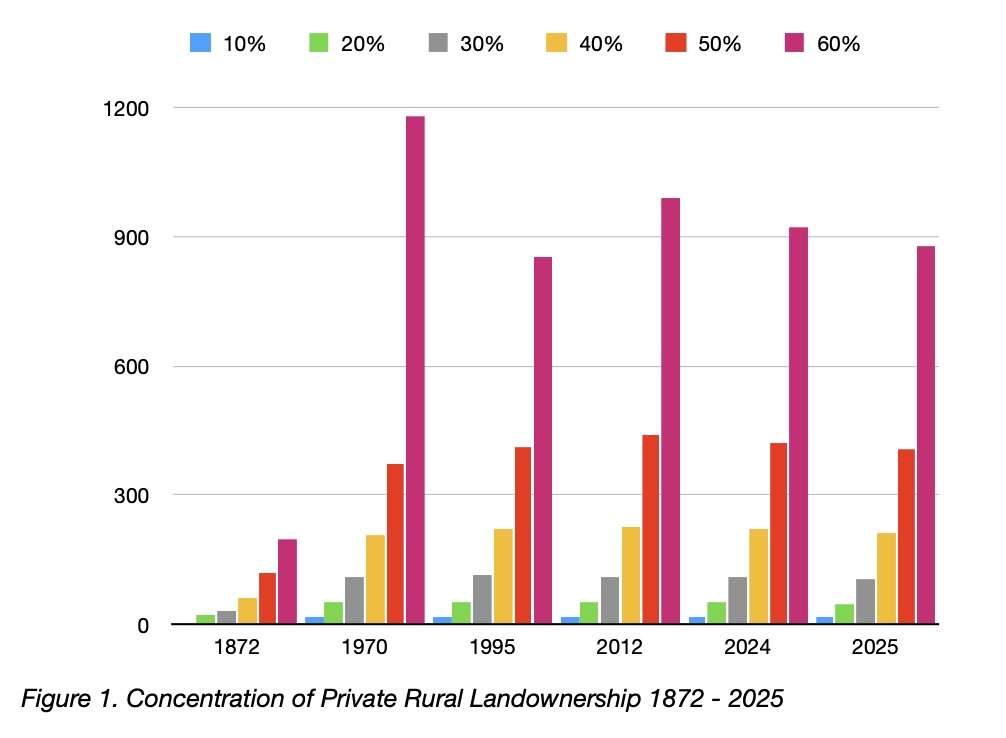
Since the survey of 1874, this pattern of concentrated ownership (half of rural Scotland was then owned by just 118 landowners) has been very slowly changing with more and more (though still very, very few in absolute terms) owners owning more and more of Scotland. This trend continued until some point between 2005 and 2010 (I have not yet established the exact date).
In 2012, 440 owners owned 50% of the privately-owned rural land, 989 owned 60% and 3161 owned 70%.
Certainly from this point onwards the long slow but steady reduction in concentration evident since 1874 goes into reverse. Statistics published in the 2024 report reveal 421 owners owning 50% and similar reductions at 60% and 70%.
Today, the 2025 report reveals further concentration over the past year with now just 408 landowners owing 50% of the privately-owned rural and, 877 owning 60% and 2413 owning 70%.
The graph at the top of this blog shows this trend with the red (50%) and pink (60%) bars showing the declining number of owners since at least 2012.
This trend has been driven by existing owners acquiring more land either by buying neighbouring land or (and more commonly), by financial investment companies such as Gresham House and others building portfolios of landholdings across Scotland. This is being driven by the economic returns and favourable tax status available from forestry and the growing speculative market in carbon offsetting and carbon credits with companies such as Oxygen Conservation and others acquiring land across Scotland. Neither of these two examples owned any land in Scotland ten years ago.
Despite the professed desire by Scottish Ministers to tackle Scotland’s concentrated pattern of landownership, nothing meaningful has been done to do so. If it had, then we would see published plans with timelines and targets. We have neither.
Instead The Scottish Government and the City of London Partnership Agreement 2026 was signed in January 2026 and follows earlier agreements in promoting and encouraging “green and sustainable finance”.
It is largely the financialisation and commodification of Scotland’s land by London based institutions that is driving the significant and long standing trend of re-concentration of landownership.
Scottish Ministers need to decide whether their priority is the interests of the City of London Corporation or of Scottish land reform for the people of Scotland.
Scotland is going backwards when it comes to tackling the uniquely concentrated pattern of privately-owned rural land. When I first published statistics in 1996, I fully expected that over time this concentration would slowly be diluted. Instead, it has increased with fewer and fewer owners owning more and more land.
There is an election in May but I am not holding my breath for any answers.
Excellent work! Thank you for doing this analysis.
It would be interesting and revealing to see a comparative graph of how land ownership is distributed in a similar northern European country. Sometimes it’s useful to see just how strange Scotland’s concentrated land ownership pattern is compared to more normal countries.
Usual excellent hard work by you Andy on behalf of Scotland . Depressing to see what is happening to our land and worse a Scottish government asleep at the wheel. As the expert in what is happening to ownership of our land can you offer any answers to this dilemma? eg…
*Lobby our government ..
*Set up a team of Scots dedicated to ( with you as overseer) finding out and identifying who is acquiring or investing in our land and for what purpose…not just for their investment portfolio.
*Insisting our government set up controls ..laws…. to protect Scotland’s land….eg triple land tax for anyone outside Scotland who owns land and a requirement to say what they intend to do with it. If this unacceptable to Scotland then they are required to sell.
I am no expert but you cannot carry this alone and I sure there are others concerned who would want to be involved in saving Scotland. If we don’t do something there will soon be no Scotland with only a tiny area somewhere for the peasants to exist.
We are at the precipice. I am quite happy to help where required.
Hi Andy.
You said:
“The core distinguishing element in Scotland’s pattern of landownership has always been the very concentrated pattern of ownership by a small number of owners. This stands in stark contrast to the rest of Europe. This contrast is mainly explained by Scotland’s law of inheritance whereby children have no legal right to inheritance land.”
I don’t understand. What do you mean when you say that children can’t inherit land?
Cheers,
Michael
I did not say that children cannot inherit land. Clearly they can and do. But they have no legal right. If land is left to them in a will, they inherit it but if it is not, they don’t and have no legal right to it. Legal rights are restricted to moveable property and not heritable property. If someone dies intestate, the situation is different.
Why did the abolishment of the law of male primogeniture in 1964 not improve this situation?
It did improve things as it abolished primogeniture in cases of intestate succession and introduced rules of legal and prior rights. It did not, however abolish the distinction between heritable and moveable property with no legal rights being created for heritable property menaing an owner can bequeth it to whoever they like and there is nothing their children can do to challenge that, Culturally this means much land is still bequeathed to eldest son
This is so depressing.
Amazing work, thankyou. Just wondering how does croftland fit in ? I think on Scoraig the land belonged to andrew lloyd webbers wife. So would qualify as private ownership, un;ess part of community buy out?
croftland is a tenancy status. All croftland is owned by someone and the analyis I published is of landownership not tenancies.
Andy
You can see this on the ground, just look at google earth, land that was once open for all is now fenced off.
Where two fences meet gives an idea of the concentration. We find it unbelievable that the tax payer is funding two eight foot steel fences inches apart, just too denote ownership, no magic money tree, just in your face, literally,
Respectfully as ever, Howie.
The crucial change came in 2005, nothing to do with land reform or lack of it, but all to do with govt subsidy to agriculture.
Before 2005, farmers were paid to keep sheep and cattle and grow crops, and
Landlords or other non farmers had no access to these funds.
The single farm payment changed all that in 2005.
The link to food production was removed and money was paid simply for owning land or occupying it.
The landlords then declared war on tenant farmers, evicting them wherever possible and claiming the subsidy themselves, leaving the land to grow weeds and putting thousands of shepherds and other farmworkers on the scrapheap..
Investment companies also started jumping in, forcing the price of land way out of reach of farmers.
Landlords also went to court to grab the subsidy in rent if they couldnt evict the farmer.
This was a bad situation, but incredibly after 2013 scotgov made it even worse by making it even easier for landlords to evict tenants and claim all the subsidy.
There also absolutely no limits on what a landlord can claim . If he can remove every tenant from his 20,000 acres, the scottish govt will pay him £2million pounds EVERY year for the forseeable future with no questions asked.,
While the countryside is emptied of people..
Till this unbelievable situation is addressed, fiddling round the edges with land reform is utterly pointless and land concentration will only get worse.
Fantastic work, Andy. What is clear, is that independence wouldn’t solve this issue (I’m a supporter of independence). It’s a deep rooted, systemic issue, the solution to which appears to lie outwith mainstream political discourse. There’s a vulgarity to individuals (humans only, of course), or entities, owning such a large volume of land, regardless of who they are and what they intend to do with it. The issue seems, to me, to go to the heart of private property and what it means to “own” land. I don’t think the level of philosophical discussion required would ever take place in a British parliament, UK or holyrood. Just as it’s impossible to discuss the existing economic system with any degree of maturity. It’s a sad thing. Politics today is more notable for what it doesn’t discuss than what it does.
You are right – this topic needs a far more fundamental debate than tends to happen.