MINISTERS CONFIRM SCOTTISH LAND COMMISSION MEMBER REDUCTION
WEDNESDAY 26 AUGUST UPDATE
Further to my blogs (below and 21 August), the Cabinet Secretary has now provided an on the record statement to Third Force News yesterday (25 August) as follows;
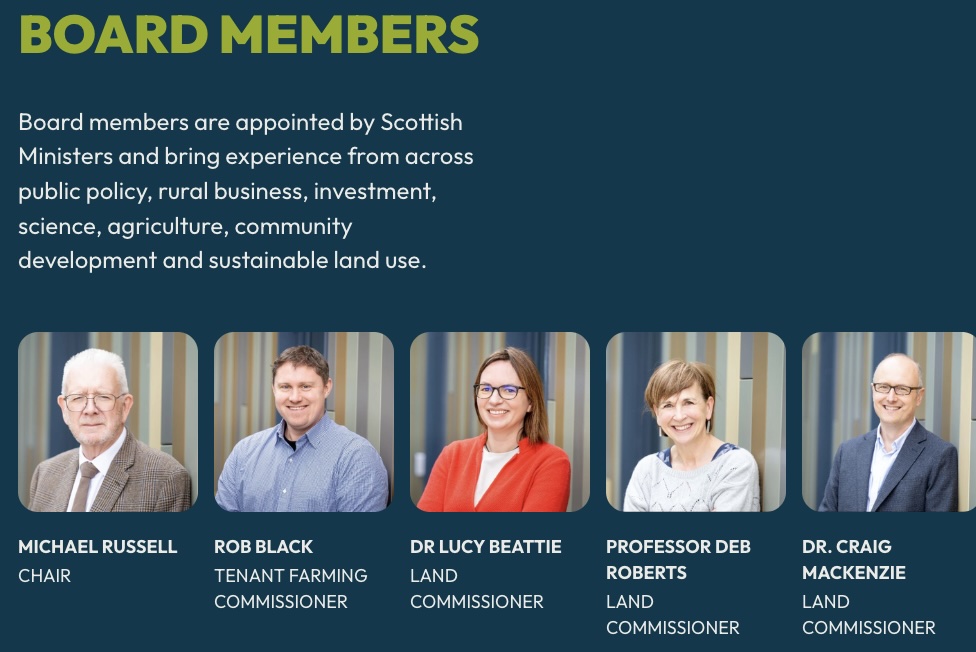
Cabinet Secretary for Climate Action and Rural Affairs, Gillian Martin, told TFN: “I intend to lay regulations in parliament to amend the number of Land Commissioners at the Scottish Land Commission. This will reduce the number of land commissioners from five to four.
“Whilst there will be a vacancy ahead of this Scottish Statutory Instrument coming into force, this does not affect the ability of the Scottish Land Commission to carry out its functions and Scottish Ministers remain compliant with the requirements of the 2016 Act.
“This decision has been taken in the context of our public service reform agenda. It is right we seek opportunities to make savings, however modest, when appropriate opportunities arise.”
This appears to make clear that cost saving is the main driver of this proposal. So, what do Land Commissioners cost? Based on the Scottish Land Commission’s 2024-25 Annual Report, Commissioners costs totalled £76,645 (page 28 of Report). This equates to an average of £15,329 per Commissioner for the year. The financial saving is thus insignificant in comparison to the wages and expenses of Scottish Ministers.
But what is more curious is that on 14 August, the Cabinet Secretary appointed a new member to replace a retiring member on the NINETEEN strong board of the Cairngorm National Park Authority. According to its 2024-25 Annual Report, £210,168 was spent on Board Members’ fees and expenses (page 79) which equates to £11,061 per Board Member.
And so the Cabinet Secretary who proposes cutting Commissioner numbers from five to four to save £15,329 is the same Cabinet Secretary who was seemingly content to replace retiring Board member of the National Park Authority and forego a £11,061 saving. Why?
Is there now a policy of reducing members of all public boards when vacancies arise to save money?
What consideration is given to the effectiveness and good governance of Boards as a result?
Why is a NINETEEN member board thought important enough to keep fully staffed but a five member is not?
These and others are questions for MSPs to pursue although I expect SNP MSPs will be told to vote for the change and Reform and possibly the Conservatives will go along with it so it will happen despite any substantive criticism that may emerge if the proposal is scrutinised at all (it requires an MSP to lodge a Motion to Annul in order for theie to be any debate and vote).
MONDAY 24 AUGUST 2026 UPDATE
This blog provides an update to my previous one of 21 August 2026 in which I reported that Scottish Ministers were planning to reduce the number of Scottish Land Commissioners from five to four following the resignation of Calum MacLeod on 31 May 2026.
First of all, in my opinion, Scottish Ministers have been in breach of the law since Calum MacLeod resigned on 31 May 2026 because from that date there were no longer five Commissioners as required by Section 4 of the Land Reform (Scotland) Act 2016.
I think it would have been a defence for Ministers to have stated publicly on or before 31 May that they planned to amend the number from five to four but that due to the recent election and the fact that Committees only started sitting in late June, a regulation under Section 4(5) of the 2016 Act would be introduced to Parliament after the summer recess.
However, this is all academic, since I received a letter today from the Scottish Government’s Land Reform team. The letter confirms that the Cabinet Secretary will be laying the relevant regulation to reduce the number of Board members from five to four.
As stated in the letter;
Isn reaching this decision, Scottish Ministers considered the Commission’s current and future functions, including those introduced through the Land Reform (Scotland) Act 2025, alongside the Scottish Government’s wider programme of public service reform. This includes a continuing focus on ensuring that public services are delivered efficiently and effectively, while making the best use of public resources.
The regulation (in the form of a Scottish Statutory Instrument) will now be laid in the Scottish Parliament. By convention, the Instrument will come into force 28 days later unless any MSP lodges a motion to annul within 40 days. That motion is governed by Rule 10.4 of Standing Orders and will be debated by both the relevant Committee and by the Parliament as a whole.
It is vital that the relevant Parliamentary Committee scrutinises this proposal. From the letter I received today and the argument highlighted above I see no good reason for reducing an already small Board from five to four members.
Key skills have already been lost and by law Ministers must regard to the desirability of the Commission as a whole having the expertise and experience set out in Section 11 of the Act, namely;
11 Eligibility for appointment
(1) In appointing members to the Commission, the Scottish Ministers must—
(a) have regard among other things to the desirability of the Commission (taken as a whole) having expertise or experience in—
(i) land reform,
(ii) law,
(iii) finance,
(iv) economic issues,
(v) planning and development,
(vi) land management,
(vii) community empowerment,
(viii) environmental issues,
(ix) human rights,
(x) equal opportunities,
(xi) the reduction of inequalities of outcome which result from socio-economic disadvantage, and
(b) encourage equal opportunities and in particular the observance of the equal opportunity requirements.
(2) In appointing the Land Commissioners, the Scottish Ministers must take every reasonable step to ensure that at least one of the Commissioners is a speaker of the Gaelic language.
With just four Commissioners this is impossible. For example, there is no current Commissioner with expertise or experience in law or in planning and development. As far as I am aware no current Commissioner is a speaker of the Gaelic language (Calum Macleod was).
It is now up to Parliament to try and understand why this decision has been taken. In relation to the argument about efficiency and effectiveness, the Cairngorm National Park Authority has NINETEEN Board Members and the latest vacancy has been filled as highlighted in my previous blog.
Why reduce an important public body from five to four but retain a National Park Authority at NINETEEN?
I hope we get some answers soon.
This proposal should be rejected by Parliament.
NOTES
[1] Although I can read the pdf letter sent to me, it requires a password to open it when I upload it to my blog. I do not have the password and so the copy displayed is a screenshot.
Call me cynical but basicly the Government don’t want to govern about land issues. The fewer memebers and the less expertise then the less bother they will have. All they do is tinker at the edges, just footering about. It should be one of the most important issues and if they really want independence and a different future for Scotland it should up front and centre and if anything, the committee should be enlarged to make sure that all that expertise is actually there and there should be representation from all parts of the country.
Site looks great.
Now why I wonder are they are reducing the number…….(rhetorical question..we know)
There seems to be a hidden insidious war against Scotland surreptitiously goIng on against our country at present..and I would think anything to do with Scotland’s land ..(much owned by foreigners )…..would be in the front line for attack. Our industrial infrastructure suffering from a scorched earth policy…Mossman..Grangemouth and recently a Chinese proposal for a big investment in the Highlands BLOCKED by the UK government even though Chinese investment appears all over england… such as .super Chinese embassy in London …..nuclear…..airports..all acceptable….. but not for Scotland.. security issues we are told and nothing else…It’s quite obvious what is going on….anything to weaken Scotland…. especially if Independence rears it head …somebody should waken the Scottish government….
However as far as the Land battle goes we have a Land Warrior…Thank you Andy.
The Land Commission has shifted from being a significant body – sound evidence base, wide engagement and with strong leadership. Without getting too personal it has effectively been brought “in-house” with zero attention paid to high standards of governance. This is an issue for the Scottish Government that costs little and has huge impact – health boards, and the array of quangos that we have. In all the SG public appointments leading to an often dire collection of people (men in the main) little emphasis is given to the vital need for high quality governance. Search for this and search in vain. The Scottish Land Commission is another casualty.