Two Thirds of Overseas Entities fail to comply with Transparency Law
Following recent posts about my attempts to secure prosecutions for those failing to register the controlling interest in land, I am pleased to see that the Ferret has published an important analysis of the Register of Controlled Persons in Land.
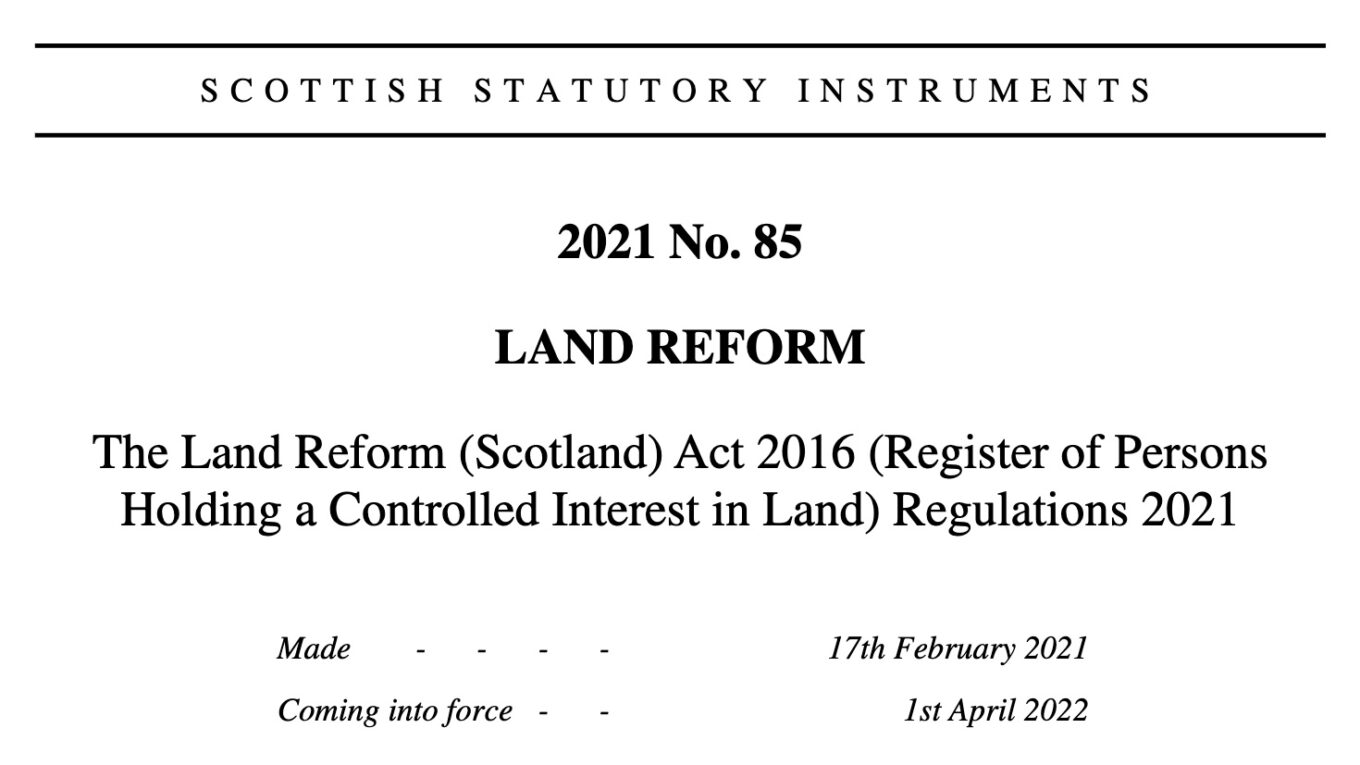
The Register of Persons Holding a Controlled Persons in Land (RCI) was established under Part 3 of the Land Reform (Scotland) Act 2016 with the relevant regulations passed by the Scottish Parliament in February 2021 and coming into force on 1 April 2022.
Jamie Mann and Petra Matijevic have examined all of the known offshore entities in the Land Register and checked whether they have made a declaration on who controls them in the RCI. In results that are both shocking and unsurprisingly they found that two thirds (956) of the 1447 offshore entities that own Scottish land registered in the Land Register have failed to register a recorded person or any associates.
These 956 entities control 2959 landholdings, over 60% of which have no entries.
Section 10 of the Regulations requires such entities to submit details of the entity (termed a “recorded person” in the legislation) and any associates. Section 10(8) makes clear that failure to do so is an offence and any person committing such an offence is liable on summary conviction to a fine not exceeding Level 5 on the standard scale (currently £5000).
When the Register was established in April 2022, the then Environment and Land Reform Minister, Màiri McAllan said:
“The launch of this new register marks a significant milestone in making land ownership in Scotland more transparent. I want to ensure that there can no longer be categories of landowner or tenant where, intentionally or otherwise, control of decision-making is obscured, including in or via overseas trusts or entities.
“Scotland has a long history of land reform and this journey to make the ownership and use of our land and assets fairer marches on.
“The new register will make Scotland a frontrunner in Europe and deliver greater transparency than any other part of the UK. It enables the public to look behind land ownership and identify those who ultimately make decisions.”
Those required to register were given one year (to 1 April 2023) to comply before failure became an offence. This was extended by a further year to 1 April 2024. So all of this entities who have so far failed to register have had over four years to do so.
Despite my efforts at reporting non-compliance to the Police, there have been no prosecutions.
Assuming (and it is fair to do so) that 99% of these 956 entities have committed an offence, that equates to £4.7 million in uncollected fines. Those committing a criminal offence include the Emir of Qatar, Sheikh Tamim bin Hamad Al Thani (poictured below).

And this is probably just the tip of the iceberg. The 956 entities are those whose landownership is registered in the Land Register. I have a list of several hundred others whose titles are still in the Register of Sasines
And overseas entities are only one of five types of organisation required to register. The others are unincorporated bodies, trusts, partnerships and those with a contractual arrangement with an individual.
There are exemptions set out in Schedule 2 of the Regulations. These include bodies with charitable status, companies under Companies Act and European public limited companies.
We have no idea of the level of non-compliance for these other categories since no-one is monitoring compliance.
With no monitoring of compliance and no prosecutions, the Register of Control Persons in Land is evidently a voluntary register rather than one requiring mandatory compliance. Màiri McAllan’s ambitions set out in 2022 are meaningless.
In the currently unlikely event of a prosecution, if an entity fails to comply, even after being fined, the penalty for subsequent non-compliance remains a maximum fine of up to £5,000, even for repeated or ongoing failure.
Because failing to register or update information on the Register of Persons Holding a Controlled Interest in Land (RCI) constitutes a summary offence, the legal mechanism treats continued non-compliance as a series of separate, repeating offences. This means that while there is no escalating higher tier of fine or prison sentence in the original regulations, the entity can theoretically face successive summary convictions and fines for every separate period or instance they fail to comply with an information notice.
For example, if an entity continues to intentionally withhold information after being convicted and fined, authorities can issue further formal requests or initiate new court proceedings, leading to additional fines of up to £5,000 per subsequent conviction.
Unlike some modern transparency legislation—such as the UK Register of Overseas Entities which explicitly implements automated “daily default fines”—the RCI framework relies entirely on standard summary criminal prosecutions. Because there is no mechanism for an automatic “rolling” daily fine, a repeat fine can only be issued as frequently as the authorities can realistically investigate, report, and secure a new conviction in court.
To issue a second fine, the police and prosecutors cannot simply point to the original failure. They must establish that a new, distinct offense has occurred. Typically, this requires Registers of Scotland to issue a fresh formal request or security notice, wait for the response period to lapse, and compile a new evidentiary file to report to Police Scotland.
Because each fine requires a summary conviction, the timeline is completely bound to the speed of the Scottish criminal justice system. A single case passing from a police report to a Crown Office and Procurator Fiscal Service decision, through to a pleading diet and sentencing in the Sheriff Court, easily takes several months. Therefore, multiple convictions within a single year against the same entity are logistically highly improbable.
Under Scots law, standard summary offenses are subject to a six-month statutory limitation period. The prosecution must formally initiate proceedings within six months of the offense being committed. This means authorities must actively manage non-compliance in discrete blocks of time; they cannot wait several years and then launch a dozen consecutive prosecutions all at once.
In practice, repeat fines would look like a slow, rolling series of annual or bi-annual prosecutions rather than immediate, rapid-fire penalties. The costs of doing this and following the subsequent processes will, in all likelihood exceed the amount of the fine so there’s no incentive for the authorities to enforce this legislation.
In the highly unlikely event of a prosecution, for wealthy offshore structures or large trusts seeking anonymity, a theoretical £5,000 fine every few years will be viewed viewed as a minor “cost of doing business.”
SNP members defeated the party’s proposed land reforms at the autumn 2015 conference because they were feeble and tardy. The leadership simply ignored this vote and carried on regardless. They then changed the constitution and rules of the party to disempower members in order to virtually eliminate the possibility of future defeats. The reforms that were passed were, as expected, feeble and tardy and, unsurprisingly, they are not being enforced. Whose side are the SNP on?
The costs of mounting a successful prosecution will almost certainly exceed the amount of the fine so there’s no incentive for the authorities to enforce this legislation. This was entirely predictable.
It has been suggested that solictors will generally refuse to act for an non-compliant entity, making the land impossible to sell or lease and that banks will not secure mortgages or loans against land that violates transparency laws. I don’t see this making any difference in the real world. When land is wrapped inside an offshore trust or a corporate shell, the land itself never changes hands on the public land registry. The “owner” remains the exact same offshore entity name for decades. Instead, the ultimate control or economic benefit is transferred entirely behind closed doors through the private swapping of trustees, beneficiaries, or corporate shares. The amendments to the legislation are likely to be ineffective.
The newly appointed Land and Communities Commissioner is restricted to “monitoring and reporting” and is therefore toothless. This is just window dressing.
Wouldn’t it be simpler to make it unlawful for any land in Scotland to be owned by an entity that is not registered in Scotland for tax purposes? If landowners fail to comply, title should be forfeit to the Scottish Government.
Colin, thank you for all your well informed replies. Yes, the summary procedure is problematic. I suspect that one of the previous reports to COPFS fell foul of this. The problem with the legislation is that in the original Act little thought was given to how this might all work and the details were worked out in secondary legislation which cannot be amended when passing through Parliament. I raised the question of one off fixed fines and no escalator but I think the presumption was that all owners would be advised by solicitors and all would comply.There are also some who believe erroneously that registration with the register of Overseas Entities means they dont have to register with RCI.
I’m interested ithe comment that the SNP effectively disenmpowered. Members. How might I find more about this?
The constitution and rules of the SNP were changed in 2018. Amongst other things, these amendments gave the NEC significant power, trumped only by the Leader. It also changed the composition of the NEC such that member elected representatives are now outnumbered by unelected appointees, representatives of affiliated groups and elected politicians that must obey the party whip. The Leader can pretty much guarantee to win every NEC vote.
When members launched the “Good Guys” campaign ahead of the 2020 autumn conference to try to once again influence party policies, they won a clear majority of the elected positions but it made no difference. Sturgeon and her cabal were able to prevent the disciplinary committee from meeting, even virtually, prevent the finance committee and treasurer from seeing the accounts, prevent the Equalities Convener from speaking at NEC meetings convened to discuss issues that affected women’s rights… I could go on and on.
The changes to the constitution and rules effectively turned the party into an autocracy and completely disempowered members. Mass resignations from the party followed. Sadly, too many of the remaining members are blissfully unaware of how internal democracy has been revoked.
This is, as always., great work. It is scandalous that government are effectively turning their backs on £47m each year, let alone allowing the breaches. I take your point about the economics and there is clearly a need to amend the legislation. That said, is it not the job of civil servants to enforce the law? The implication of your reports to the police would appear to be that they do not see theprosecutoond as being in the public interest. My feeling is that there are significant numbers of the public who would be seriously concerned if they understood the issue. Has there been any attempt to raise the temperature using. social media?
This makes me so angry and frustrated.
‘The new register will make Scotland a frontrunner in Europe and deliver greater transparency than any other part of the UK.’
In England and Wales a level 5 conviction in a magistrates court carries an unlimited fine. We’re scarcely a frontrunner and we’re not delivering transparency.
Just keep going Andy and if help required we are here. Maybe somebody could waken up the undead in Holyrood and alert them …you probably have already done so..
Thank you for all your hard work on behalf of Scotland..