Ferry Rights and the Skye Ferry
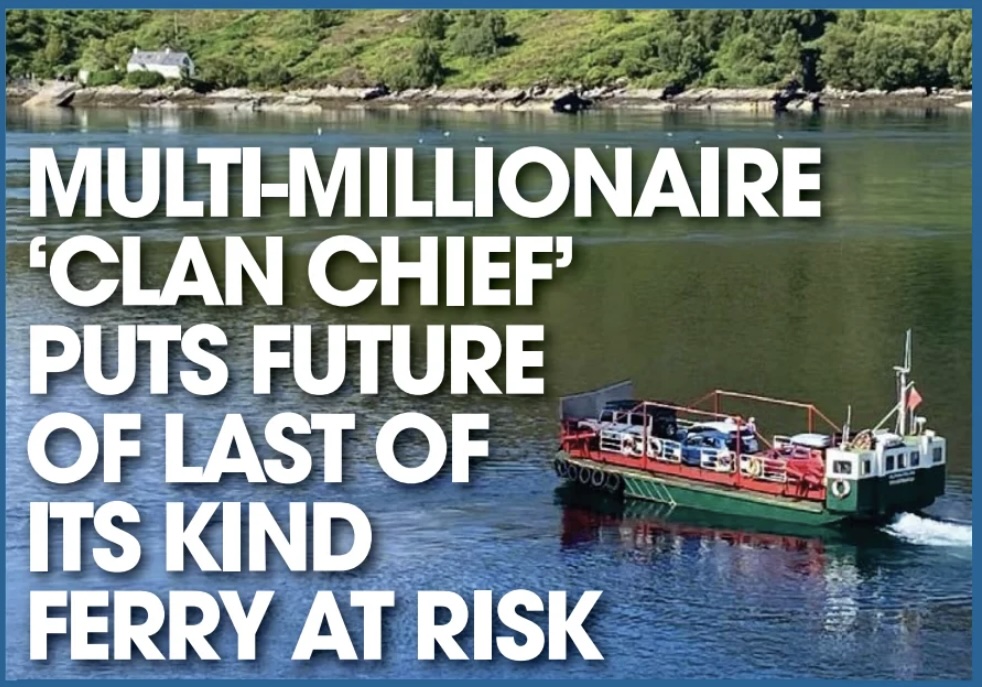
The image above appeared on the front cover of the Sunday National on 16 August 2026. The story highlighted the ongoing charges faced by the Isle of Skye Ferry CIC, the community company that operates the Glenelg – Kylerhea ferry and the impact this could potentially have on the viability of the community run ferry service. You can read a transcript of the story on the walkhighlands website here.
This blog explores some of the background to this situation, how it came about and how it might be resolved.
First of all (and to get this off my chest) this is yet another story about an archaic aspect of Scots land law that joins a long list of topics that have not yet been addressed in any of the land reform legislation of the past 25 years.
It is is closely related to the need to modernise the law of the foreshore and the seabed, a topic referred to the Scottish Law Commission by Jim Wallace in 1999 as part of the Scottish Executive’s land reform action plan. The Commission published its report together with a draft bill in 2003. It included proposals to strengthen public rights in the foreshore and seabed. In the 23 year since, nothing has been done to implement these recommendations. Had they been implemented, many people and businesses would have benefitted.
FERRY RIGHTS
So what is all the fuss about?
In Scots law, ferry rights are “a separate tenement” in land alongside such things as salmon fishings and minerals. In other words, they can be owned separately from any land. In addition, ferry rights (the exclusive right to convey passengers and their baggage) is, by default a Crown right. This is reflected in Scotland’s most famous historic ferry crossing between South and North Queensferry. The clue is in the name. Queen Margaret exercising the powers of the Crown, established a ferry across the Forth.
By default, the Crown still owns the right to ferry across any stretch of water unless it was alienated to a third party. In practice this is what has happened in the majority of contemporary and more recent ferry crossings. The rights were conveyed to Royal Burghs and Burghs of Barony who exercised the rights and which in turn were transmitted down the centuries to current local authorities.
Most of the public ferry routes today operated by Calmac have their origins either with private companies established before David MacBrayne Ltd was nationalised in 1948 (including railway companies). Alternatively, they were established without seeking a Crown grant and the Crown appears never to have objected (or perhaps they consented without the need for any conveyance of the right).
A helpful blog explaining all of this was published by retired solicitor Neil King back in 2013. The only part of his analysis that I would disagree with concerns his assertion about the role of the Crown Estate Commissioners (now Crown Estate Scotland) in relation to ferry rights. Like a number of Crown property rights, the granting or exercise of the Crown right of ferry has got nothing to do with the Crown Estate. Any grant of a Crown right to ferry awarded today would have to be sought from HM King Charles directly.
KYLERHEA FERRY RIGHTS
In the case of the Glenelg to Kylerhea crossing, this is an ancient route named after Reatha, a Fingalian hero who is said to have vaulted the fast flowing Caolas an Lamhachaidh (the strait of dextrous handling) in the third century. For centuries it was used for driving cattle to lowland markets and for conveying passengers long before Kyle of Lochalsh existed as the modern crossing point.
The ferry rights on the mainland (the Glenelg side of Kyle Rhea) were owned by the Burton Property Trust, the family trust of the Baillie family of Dochfour, who acquired the Glenelg Estate from Lord Glenelg in 1837 with the proceeds of slavery compensation monies. Lord Glenelg in turn had acquired the lands from Macleod of Bernera who had been granted the lands around the 14th century (early chiefs were sometimes formally designated as Macleod of Glenelg).
On the Isle of Skye, the lands historically belonged to Lord Macdonald, Lord of the Isles. The lands would eventually be held by Crown charters with the most recent being that of 1727 when Sir Charles Macdonald was granted a charter restoring Jacobite-era forfeited estates.
Whether through inclusion in these charters by express terms or through the simple fact that the Macdonalds on the Skye side and Macleods on the Glenelg side owned the land, they came to be possessed of the ferry rights and were in possession of them when Boswell and Johnson made their famous visit to Skye in 1773 crossing the Kyle Rhea by ferry.
The ferry rights were then transmitted to successor owners over the intervening years. The Burton Property Trust transferred ownership of the ferry rights on the Glenelg side to the Isle of Skye Ferry CIC in 2025.
On the Skye side, the small estate of Kylerhea was sold by the Executors of Lord Macdonald following his death in 1970 as part of the vast sale of the Macdonald Estate (large parts of which were acquired by Sir Iain Noble and the Clan Donald Lands Trust).
In 1972, 225 acres in Kylerhea were sold to Reginald Godfrey Laurence Oliphant. A further 40 acres were sold to him in April 1975. Kylerhea Estate was then inherited by his son (now current owner) Richard Eric Laurence Oliphant in 1991.
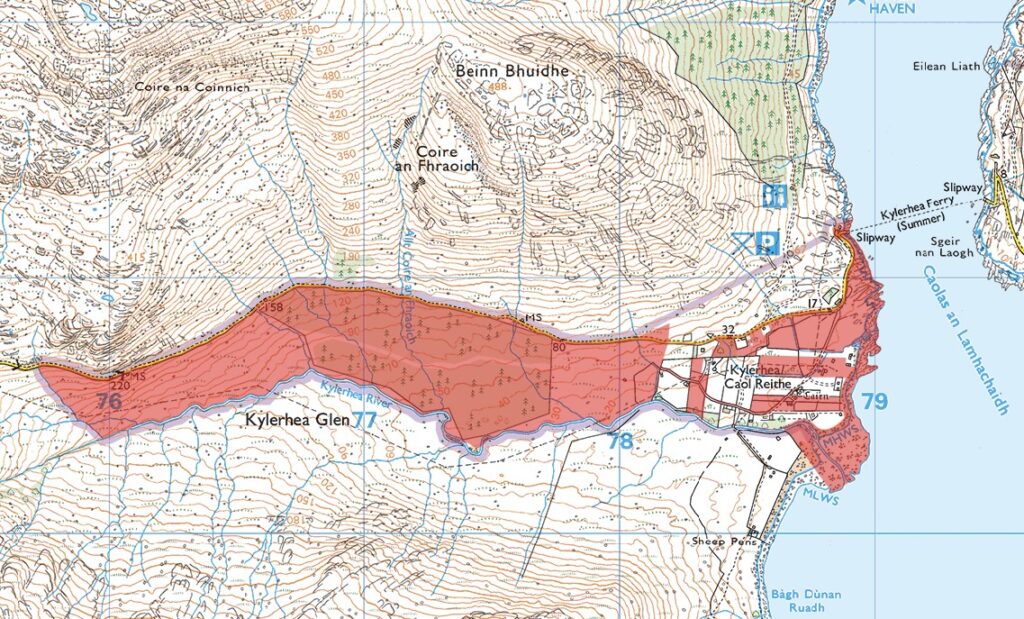
Revealingly, in 1998, there was then a corrective disposition (1.9Mb pdf) specifically conveying the ferry rights as they had not been conveyed back in the 1970s. All of this is to confirm that Richard Oliphant is the owner of the Kylerhea Estate (see map below) and of the ferry rights, a heritable property right originally granted by the Crown to Lord Macdonald. [1]
RICHARD OLIPHANT
Speaking to a long time resident of Kylerhea, I was told that Reginald was a lovely man. On one occasion he had approached this resident and pointed out that he didn’t really have much room beside his croft house to park his car and would he like another quarter of an acre? Yes please, said the resident and Reginald conveyed it to him for £1.
Reginald did lament the fact that his two sons were “the bane of his life”.
When Richard inherited the estate, everything changed. Suddenly, he wanted every penny in income he could get. Locals describe him as a pompous buffoon and one reported that he was widely detested.
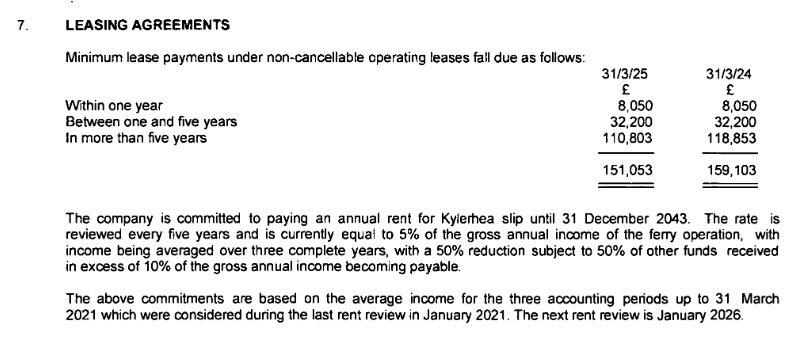
From the beginning of the Isle of Skye Ferry CIC, Oliphant has been charging a fee to allow the Company to use the ferry rights. Initially set at 2.5% of turnover, it is now 5% of the gross annual turnover and can never be less than any previous year’s fee regardless of the income of the Company. The potential for this to cause severe financial difficulties to the Company was the reason why it took the decision to speak to the media. In the latest accounts for the Company these liabilities are noted (see below).
Up until the community took over the ferry, Richard Oliphant had leased the slipway to Highland Council and the Council appeared to have looked after any costs. I was told that he previous operator, Roddy Macleod, had told Oliphant where to shove his claims for ferry fees.
To secure the necessary loans and other compliance, the Community Interest Company had to demonstrate that they had a right to ferry. The only way to secure this was to agree a lease with Richard Oliphant. They had no alternative. The lease grants the Isle of Skye Ferry CIC the Kylerhea slipway, the heritable but non-exclusive right to the landing rights at the slipway and the heritable but non-exclusive rights to the whole ferry rights to and from the pier.
Despite him doing nothing to support the business and having invested nothing in it, he secures an annual income in excess of £15,000 and rising in perpetuity for as long as the ferry continues to operate. He also secures free pedestrian and vehicular passage at any time for himself, his spouse and children and any guests at any time.
As the article in the National notes, he has refused the company permission to upgrade the run down shed and dilapidated telephone box at the top of the Kylerhea slip to provide a welcome notice, timetable, and opportunity for merchandise sales.
In short, Richard Oliphant is holding the Company to ransom.
I contacted him to ask for his response to the media reports and to ask him why he felt the obligation to skim off a percentage of the Company’s turnover in exchange for nothing. I asked him the following four questions.
1. What is your response to the attached media article?
2. Why do you insist on charging 5% of the gross turnover of the Skye Ferry Company for the right to exercise ferry rights and use the Kylerhea slipway?
3. In particular do you think it right, proper and moral to charge for the exercise of ferry rights which you paid nothing for?
4. The media article describes you as “super-rich” and a “millionaire” absentee landowner. From what I can gather you are neither. Can you confirm that this is indeed the case?
5. Are there any circumstances in which you would agree to convey the ferry rights and the slip to the Skye Ferry Company as has been done on the Glenelg side?
I asked him to respond within 24 hours and followed by by leaving a message on his mobile. I have received no response.
THE FUTURE
As noted above there are numerous issues with the Scots law of property that have not been addressed by land reform which, instead has focussed on land tenure reform (abolition of feudal, leasehold reform etc.) and providing rights to community bodies to acquire land. [2] Across Scotland, for example, there are examples of new lairds inheriting substantial estates and jacking rents up, demanding excessive payments for the right to take utilities and across ransom strips to a new housing sites (John Swinney should ask around the next time he visits Tiree about the activities of Argyll Estates), or demanding fees for access to the foreshore for seabed businesses that previously had taken such access for nominal or no fee.
Even as I put the finishing touches to this blog, another story reaches me of a community company deciding to wind up as it can no longer provide internet services due to the intransigence of a new local landowner who is refusing to enter into a new lease
The exercise of such monopoly power cannot be resolved only by expecting the community as a whole to take ownership (which in most case they never can anyway as the land is not for sale). Land reform should also be about promoting rural development and allowing individuals, households and businesses to go about their business without a monopoly laird demanding payment often for a right that they themselves (like Richard Oliphant) never paid for themselves.
It is a measure of how far we have to go to modernise land law that in 2026, it is lawful for privately owned ferry rights to be owned and exercised in such a way as to frustrate the financial viability of widely admired, valued and historic modes of transport such as the Glenelg to Kylerhea ferry crossing.
I don’t propose to publicise here the possible ways forward. I will be discussing these with the Company. Suffice to say, a strategy is required to ensure that Oliphant cannot continue to profit from the monopoly control of ferry rights and threaten the future of the Skye Ferry.
The historic and ancient rights that Oliphant is controlling may not in fact prove to be everything they appear to be. Hold on for a potentially rocky and bumpy ride testing the limits of the Crown right to ferry.
Finally, it is worth concluding by noting that Richard Oliphant is the Chief of the Clan Oliphant whose motto is Tout Pourvoir – Provide For All.
So far, he is providing for nobody but himself.
NOTES
[1] Oliphant’s title is recorded in the Land Register INV52798.
[2] It is with noting that I was a member of the very first Scottish Land Fund which, unlike the current one, was entirely independent of the Scottish Government. We approved funds to enable the community to acquire the ferry but it was conditional on the community as a whole agreeing to do so in a ballot which they failed to do by a margin of 60 to 39.
I felt strongly at the time that such funds should be available to a community company and social enterprise consisting those members of the community (and others) who DID want to proceed and should not have to rely on the whole residential community. I still feel this is a big weakness in land reform legislation giving people with no interest or who are hostile to community acquisitions an effective means of thwarting those who have the energy and drive to make it work.
I had read about this disgusting affair in the National, and while I was of course enraged by the arrogance of this ‘person’ I wasnt surprised. The Scottish Government needs to take on those who think Scotland is some kind fiefdom…. it reminds me of the Bulloughs of Rhum but with the added twist of legalised extortion. This is our country, not theirs.
This must be changed in short order by Act of Parliament to send a message to his ilk… most of all he must be disavowed of the idea that some things never change. It is the one thing that irks me about the island I live on (not Skye)
i do feel giving the guy only 24hrs to respond to your email may be counterproductive. If I received an ultimate like that in an email, id hit the delete button or at least make sure I waited a month to respond. Just saying.
More than most people get in response to a media story. Lawyers recommend 4 hours. In any case, perfectly possible to acknowledge receipt and offer a more extended timetable. But I think we can assume this guy is not interested in replying at all.
I am, unfortunately, well aware of this. I am very fond of Glenelg, visit often, know quite a few locals and the Ferry is a customer.
By and large it is a great example of a go-ahead community. If the ferry were to disappear it would become a “dead end” in that anyone going there would have no choice but to return by the same route (and it is a very senic route with wonderful views to the Five Sisters and suchlike). The Ferry is an attraction in its own right being the last manual tuntable ferry in the world and like the Waverley should be regarded as another nautical National Treasure. It is the best way, from a tourist view, to get to Skye.
Without this link the community would be diminished in various ways, not the least being economic. This cannot be allowed to happen.
The lairdie’s actions are dispicable to say the least, I am so glad to see that you have taken up this extortion racket as a cause.
If there is anything that you think I might usefully do just let me know. I’ll certainly start doing what I can in the online world and personal contacts.
Well done again Andy for publishing this article. It annoys me intensely that this Scottish government has done so little in 19 years on land reform. I will forward your email on to my MSP for comment. If I get response I will forward it to you.
A Fifer who knows the area and likes the ferry.
Thanks Andy for all your continued work.
Would the ferry rights or ferry approach merit a compulsory purchse by either local or Scottish government?
You said “Any grant of a Crown right to ferry awarded today would have to be sought from HM King Charles directly.”
Can the King be petitioned to remove the rights of ferry from the Oliphants and give it to the CIC?
I have seen in the past that when there is a landslide on the Strome to road the ferry then operates from Strome Ferry across Loch Carron, this whole scenario could see the end of this happening.
No, the ferry rights cannot be revoked by the Crown. Read the piece by Neil King to find out about the Strome crossing – ferry rights there are owned by the Cumming family (or were in 2013)
If King Charles represents the ‘Crown’ as there’s no British crown which crown does he represent?
Rights to ferry are a historic right of the Scottish Crown. Like other crown rights (ultima haeres, bona vacantia, foreshore etc) they are administered by various parts of the state.
Thank you
The ferry owners should start a “go fund me ” then everyone could donate to a separate charitable trust and leave a comment about their view of the Olephant chap. (Apologies if that is already in place). That money would be outside the turnover of the ferry but could pay his ransom if enough was raised each year.
Other points that might be worth looking into: unfair contracts can be overturned in the court .
And why percentage of turnover?
Even HMRC don’t use turnover to calculate tax, but use profit.
This is appalling, bullying of the worst possible kind. Have you considered informing Private Eye? It is exactly the sort of case that they are very good at highlighting.
Good suggestion!
Agreed !
Thank you for this most informative article. Is it possible for an Act of Parliament possibly through a private members bill to cut the Gordian knot? It would be I suspect rather delicious to hear their Lordships’ deliberations on any sequestration attempts. Or can it be dealt with in terms of a compulsory purchase sale. I rather like the idea of haling this Oliphant down to Westminster to speak to a committee of MPs but alas we don’t have the Gwyneth Dunwoodys or the Baroness Trumpingtons to make mincemeat of these naughty boys.
An Act of the Scottish Parliament could (and should) convert all private ferry rights to pubic rights held by local authorities. After all, leasehold was abolished, feudal burdens were abolished etc. The problem is that there is no appetite for a systematic examination of Scots land law with a view of promoting modernisation and democratisation. See example with the foreshore I highlight in blog 0 over 20 years and still waiting.
Records suggest that Richard Oliphant became Company Secretary of the Ferry CIC in May 2007..
Through 2007, the CIC completed acquisition of the Glenachulish with the community funding package. (which I believe required the CIC to demonstrate that they had Rights to Ferry across the Strait).
Records suggest that Oliphant left the position of Secretary in December 2007.
Did Oliphant, while Company Secretary, participate in the CIC’s discussions, negotiations or execution of an agreement that gave him a financial interest?
So…from my understanding the ferry pays £10000 for use of the landowner’s land and slip…is that not rent? £10000 yearly rent for what is a commercial outfit taking money for it’s use for what looks like is making £100000 a year, from the extract.
I don’t make any money on rent for my home, and I pay more than the ferry. How is this unfair or demanding of great bluster?
The CIC pays rent for the slipway, the heritable landing rights and the heritable ferry rights. These are monopoly rights held by someone who is under an obligation to the Crown to provide a ferry and has not done so, who is demanding (from a monopoly position) upward only rent reviews, the tenant is responsible for all repairs to the slip regardless of the cause, degree of defect or damage necessitating such repair and is not entitled to compensation. In short this is monopoly rent-seeking.
Nothing at all like rent for your home. You can move to a different one if you don’t like the deal, you have access to judicial determinations of excessive rents, and are not responsible for repairs to the fabric.
Oh and you are not locked in for 30 years with no right to terminate the agreement.
So… I’m still struggling to understand why this is such an issue. They are upset they signed a lease to pay £1000 a month for a profit making business, which brings in £100000 a year? That is 1% of revenue. Businesses and charities would beg to have that low a cost of rent.
As for lease length… like anywhere where capitalism exists you don’t need to sign the terms if you don’t like them.
You have a Scottish name James but you sound quite happy for us to lose heritage and amenity.
I may have had some understanding of your points had Oliphant been a fair minded landlord. That, it would seem, he is not.
Again, heritage and amenity.
Again nothing at all like your home rental situation.
From where do you get that the CIC is making £100k? I must have missed that bit.
The lease here
https://andywightman.scot/wp-content/uploads/2026/08/account_extract.jpg
He doesn’t provide full context but it seems to be determining income vs rent costs, with income laid out as a little over £100,000.
That is not the lease. it is an extract from the accounts.
So I had a bit of time. First, I apologize. My math was incorrect.
To be paying £10,000 at 5% of your yearly income, that means the ferry is making north of £200,000.
So anyway. I wanted to know how much it might cost to run a ferry. I did a bit of googling and some maths and came to the conclusion that costs for labor and rent comes to about £100,000. My labor costs come from ferries larger than this one, so the cost is probably a bit generous. There is a charity set up beside the ferry which pays for the ship’s upkeep.
Fuel costs aren’t insignificant, but it can’t cost another £100,000. So why or how is a community trust making £50,000-£100,000 of profits complaining that £10,000 of rent is the part that’s hurting business?
=============maths sheet==============
Skipper / Boatmaster (Small Ferries)
https://uk.indeed.com/viewjob?jk=a45c21cea8a67993&from=appshareandroid https://uk.indeed.com/viewjob?jk=a45c21cea8a67993&from=appshareandroid
62,152 /52 = £1196 /wk /42hr = £28/hr
Ferry Operative – 2nd person – Jura Ferry
https://uk.indeed.com/viewjob?jk=4a27ab0e967507e3&from=appshareandroid https://uk.indeed.com/viewjob?jk=4a27ab0e967507e3&from=appshareandroid
27,992/ 52= £538/wk /42= £12
Add 15% on each for contributions
Skipper = £33 (£32.20 but being generous)
2nd Hand = £14
Timetable says ferry runs 8hr/day. Add labor time for startup and end of day
£33×10= £330 per day wages
£14×10= £140 per day wages
Timetable says it runs from April to mid October
1/04/26 to 15/10/26 is 198
Labor cost for 10 hours a day for 198 days= £93,100
Added cost for rent of slipway £103,100
CIC has to pay 5% (which cannot be less than any previous rent) regardless of their turnover. 5% of £200,000 turnover is £10,000. if next year turnover is £100,000, they cannot pay less than £10,000. Then the extremely expensive ferry to maintain cannot run for several months – still have to pay £10,000 and all of this uplifting year on year for 30 years for rights which were granted with an obligation to run a ferry which Oliphant is not doing!
So…by your argument, if I lost my job tomorrow, I should only pay my landlord what I could afford and not the set price which I have contractually agreed upon for a house which he bought in the 1970s and I signed a lease to promise to pay for the next few years?
Because according to the documentation you provided, the cost is for rental of the slip. The summation that it is for the rights to ferry is bollocks.
“The company is committed to paying an annual rent for Kylerhea slip until 31 December 2043”
The quote is from the accounts which is a shorthand interpretation of the lease (which I have not published). the lease is for a) the slip, b) the landing rights and c) the ferry rights.
So you agree. They pay rent for use of the slip. Because it is his property and they have a commercial business running from his property, he demands rent for said use. And only £10,000 for a business which only runs 6 months a year and pulls a decent profit?
If I rented land and opened a cafe would you be beating my landlord’s door down on his horrible demand at rent?
So why the clutching at pearls and tearing at clothes over this?
Surely if the Scottish government provides massive annual subsidies to other ferry routes a subsidy for this route would make sense, if all the other options are exhausted. The cic should write to the transport secretary Msp.
Thanks for the enlightening historic overview Andy. I’ll give Scottish Government the benefit of the doubt here by suggesting this case is rare enough to have been overlooked in their watered down action on land reform. But it’s come to light now so it’s time for action. With community empowerment and wealth building legislation in place, it’s surely time to reform archaic laws like this. I disagree with posts that suggest this is ‘fair rent’ for something acquired at no cost and effectively meeting an obligation the land owner is failing to do. I wish you and the company success in campaigning for change. If there’s anything interested bystanders can do (apart from wee donations to support your blog) please make it known.
Another excellent blog Andy. So many of us go through our lives unaware of the history and the legislation which allows this kind of exploitation to continue. Awareness and education is the first and fundamental step in putting such things right. Keep doing what you do,
I don’t understand why the then representatives of the CIC agreed to such stringent, unfavourable terms under this lease agreement. Why were they.not able to secure something like a set fee for the next 20 years? Were they bullied into these terms? That is what it looks like.
I don’t understand the full legal complexities around land rights and ferry crossing rights in Scotland – in spite of your very thorough explanations, which I have just read through quickly – but this ferry is situated in one of the most beautiful corners of Scotland and its loss would be tragic on so many levels and for so many people.
The whole issue seems to revolve around an incredibly greedy, exploitative landowner and a community historical asset, the representatives of which appear to have been bullied into a no win situation.
Is there no legal way to challenge the terms of this lease?
Bear in mind the ferry was for sale. The owner of the ferry rights a monopoly and holds any operator to ransom so the ferry operator does not hav emuch by way of negotiating power. The lease itself cannot be challenged but I believe that the failure of oliphant to provide a ferry (which is the obligation that comes with ferry rights) is a potentially justiciable issue.
This is a pretty unkind attack on a landlord who has a legal and binding lease entered into by a profit making company.
It resorts to name calling via an unknown third party and claims that the landlord is a multi millionaire,without a shred of justification given.
By all means question the lease if you wish but character assassination in this way is unacceptable.
As for the development of the phone box and shed on the Kylerhea side my clear recollection is that the Kylerhea community was consulted and they voted against it.
1) As far as I know Oliphant is not a multi-millionaire and I state this in the question I asked hum (still unanswered)
2)This is not a normal lease. Oliphant holds a monopoly right over a public transport route. He is thus under an obligation to provide a ferry service. he has not – instead relying on others to do so and in the case of the current operator, holding them to ransom.
3) In these kind of circumstances it is impossible to name sources given that Oliphant remains the landlord in Kylerhea and many people’s lives are to a greater or lesser degree dependent upon him.
Andy, you are an absolute star and you only interest in this debacle is in looking after Scotland, Scottish people and (in this case) our ferry transport.
I fail to understand how people can actually argue against your points.
I will sign up for any crowdfunder or public support for this ferry.
Time Scotland’s ultra rich land owners were reigned in just enough to make them play fair.
If Oliphant is under an obligation to provide a ferry service, he should be paying the CIC for doing that for him, not the other way round!
Andy, an excellent summing up!
You mentioned in question 3 a particular word, MORAL-
For me, he is a clan chief and a proud Scotsman (his claim), the answer is for him to uphold his claims – morality not money!
Disgraceful that this should even be considered for closure. Beautiful, unique, tourist draw and another access to the island. Please don’t do it.
I wonder how the general network of public roads is instituted as a wayleave through private land, given that the logistics of embarking/disembarking from water onto a public road could be seen as a public wayleave of some sort, with the commercial opportunities arising only from values-added beyond a basic level of access. This seems especially so within the long-established network of public roads. Interesting article and comments
it is achieved through the process of “adoption” as a public road rather than as a servitude. Key question here is why the slip appears not to be adopted given it is directly linked to public road network. one theory is that it was unadopted by mistake. Investigations underway.