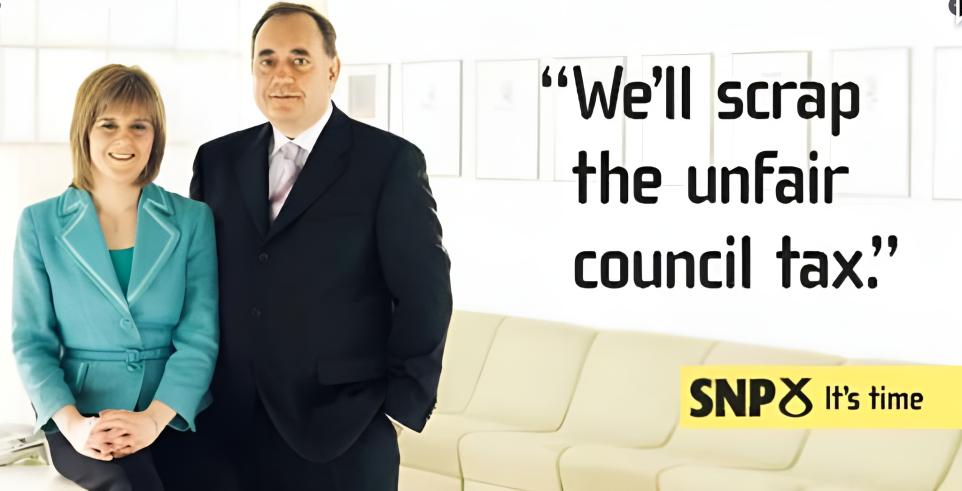
Parliament can now scrap the Council Tax
The Scottish Parliament will very soon have the opportunity to scrap the Council Tax.
This is the first time in the history of devolution that this has been possible.
This blog explains why and how this has come about.
Earlier this summer, the Scottish Government consulted on plans to introduce High Value Property Bands (popularly referred to as a Mansion Tax). The consultation closed on 24 August 2026.
The proposal is for two new bands to be added to the existing eight Bands A-H. The new bands will be for properties valued at between £1 – £2 million (Band I) and for properties worth over £2 million (Band J).
The new rates will be administered as part of the existing Council Tax system. However (and this is important), properties in the new Bands will be subject to a new updated valuation. The existing bands will all remain based on property values from 1991.
The proposals are separate from and in addition to, wider plans to reform Council tax as set out in a previous consultation.
In a previous blog in February 2024, I set out how the Council Tax could effectively be scrapped through setting new bands of £10,000 width and an up-to-date valuation. I even published a draft Statutory Instrument to give effect to these measures.
My proposals would create the equivalent of a new property tax based on actual values (in £10,000 bands for ease of valuation and to limit scope for appeals) and with an updated valuation. These are two of the key reforms needed to deal with the regressive nature of the Council Tax and the idiocy of a tax base that still uses 1991 valuations.
I advocated secondary legislation as it is quick and efficient.
MANSION TAX PROPOSAL
When I read the Mansion Tax consultation paper, I was intrigued to note that Ministers intended to introduce the new Bands I and J through primary legislation and wondered why that would be necessary. [1] New bands can be added and revaluations can be introduced through the kind of secondary legislation I drafted (see above).
In England, the proposed High Value Council Tax Surcharge will require new legislation. English proposals are for a separate tax to the Council Tax paid by owners and not occupiers with the new Mansion Tax being based on updated valuations.
This does create the rather bizarre situation where someone who owns a house worth over £2 million will pay their Council Tax based on 1991 valuations and then, on top of that, they will pay the Mansion Tax based on updated valuations. Nevertheless it is clear why fresh legislation is needed since this is a new tax.
The Scottish Mansion Tax is not a new tax.
It is merely an extra two bands on top of the existing eight.
I emailed the Local Tax team in Scottish Government using the email provided in the consultation paper to ask why primary legislation would be necessary. I did not receive a reply and have thus not responded to the consultation since my response depends on the answer to this question.
A retired civil servant, however, helpfully pointed out to me why primary legislation will be necessary.
Existing powers in the Local Government Finance Act 1992 (see for example s.74(3) which allows Ministers to alter the bands) can be exercised by secondary legislation as I outlined in my February 2024 blog. However the new Scottish Mansion Tax involves undertaking a revaluation of only those properties that are worth over £1 million today. All other properties will not be revalued.
Section 88 of the 1992 Act only allows Ministers to amend the valuation date for all of the Bands and not just for some of them. Without new primary legislation, the Scottish Mansion Tax (with its partial revaluation) cannot be introduced.
I am pretty sure this is why new primary legislation is required.
SCRAPPING THE COUNCIL TAX
In a recent interview on the BBC Radio’s Scotland Sunday Show, Shirley-Anne Somerville claimed that the lack of consensus on a replacement was a problem.
The lack of consensus among MSPs at Holyrood, she claimed, had made it difficult for her party to introduce reforms since the SNP came to power in 2007.
Quite why consensus is needed for this but a simple majority in Parliament is all that is required for every other Bill introduced by Scottish Minister is not explained.
Anyway, following the indications in the consultation paper, the Programme For Government published yesterday confirms that a Bill will indeed be introduced.
Council Tax (Scotland) Bill
This Bill will deliver the Scottish Government’s commitment to introduce new council tax bands for high-value residential properties by 1 April 2028 and is a key component of Ministers’ wider programme of council tax reform.
The Bill will address a longstanding concern that the highest-value properties can currently pay the same level of council tax despite substantial differences in market value. It therefore improves fairness and proportionality at the upper end of the tax base whilst affecting only a small proportion of properties. The legislation also provides an opportunity to modernise aspects of the council tax framework and increase local flexibility through discretionary powers for local authorities.
It is unclear what the Bill will do beyond allowing for a dedicated revaluation of high value properties.
But that doesn’t much matter.
What does matter and why I have written this blog is to draw attention to the fact that for the first time in the devolution era, a Bill will be introduced to Parliament on Council Tax.
This is important because, unlike secondary legislation which Parliament cannot amend and which Ministers can draft as narrowly as they wish, a public Bill becomes the property of Parliament following introduction.
Parliament sets the timetable and determines the scope. There will be full evidence sessions in Committee. MSPs are free to lodge any number of amendments to the Bill at Stages 2 and 3. The SNP does not have a majority in Parliament and although (as Shirley-Anne Somerville, noted) there is no consensus among the parties, there is plenty scope to build alliances to scrap the Council Tax and replace it with something much, much fairer.
The proposals that I outlined in my own Statutory Instrument could easily be incorporated if any MSP were so minded and if a majority could be secured. The name “Council Tax” can also be scrapped and replaced by the name of the new tax by amending s.70 of the 1992 Act. [2]
Labour, Scottish Greens and Liberal Democrats have all criticised the SNP for not scrapping the Council Tax.
The SNP committed to doing so back in 2007.
Now at last there is the opportunity to do so.
Is Parliament up to the job?
NOTES
[1] Primary legislation is what one normally thinks of as legislation. A Bill is introduced to Parliament, It is debated and amended and finally passes (or not), receives Royal Assent and becomes an Act. Secondary legislation consists of minor legal changes that are introduced through Statutory Instruments and Regulations. Only Ministers can introduce secondary legislation and it cannot be amended.
For example, the Freedom of Information (Scotland) Act 2002 applies to all public authorities listed in Schedule 1. But of course new public authorities may need to be added in future. Ministers have the power to do this by secondary legislation (see eg this amendment order in 2008). Secondary legislation is typically used fpor things like uprating social security benefits, redefining categories of eligible persons, settting statutory fees for public services etc).
[2] When the 1992 Act was passed, the name given to what is now the Council Tax was the regional council tax, the islands council tax or the district council tax. The name was amended to Council Tax in the Local Government etc. (Scotland) Act 1994 which scrapped regional, islands and district councils.
I would love for it to be replaced with a Land Value Tax (alongside Business Rates and SDLT).
Kind regards,
Kayed
Personally, I believe the reforms outlined are unfair to people like myself that have a relatively high value property as I live in the centre of Edinburgh where property prices have soared but my earnings haven’t and are not particularly high. I would be paying proportionally much more than many higher earners.
Local people should be encouraged and able to afford to stay in the centre of our cities which have already been hollowed out as result of over tourism and Air BnB rental.
Tax should surely be based on income and ability to pay.
My neighbours have owned their property for 40 years and shouldn’t be penalised through any such reforms or are we expected to cash in on the value of our properties and move elsewhere?
As I set out in the notes to my own proposed SI, there should be both a transition scheme and a deferment scheme. Folk living in houses that have soared in value can defer until such time as they sell when the debt can be paid out of the untqxed capital gains. Other options are available including self-valuation at a lower market value with a right of pre-emption in favour of the local authority.
Thank you for the reply. Much appreciated.
In addition to my previous comment, a garage next to us in Edinburgh was sold for more than £200,000 about two years ago.
It’s a decent garage but only suitable for two smallish cars or it’s current use for someone’s large motor bike collection. Previous to the sale, a Williams Racing car drivers pet machine was housed there, which he polished once a year and took for a spin when he was “home” from Monaco.
All of these things have an impact on the house prices next to them!
At the SLRG we propose location rent at least replace all local government taxation as a start. So it is good to know ScotGov can scrap the Council Tax. Adding extra bands to property values is a kind of progress but not radical. Replacing CT and Rates with location rent would constitute radical reform and initiate the migration to fairness: Location rent as public revenue.
So Stage 1 seems possible in the migration to rent (Annual Ground Rent) as the public revenue. This would start to cancel current Scottish deadweight losses of up to £2 for each £1 of tax currently exacted on productive activity such as wages and trade. ‘LVT’ is a tax on unimproved site rental values and therefore can be seen as a part of the kind of reformed fiscal structure we propose (basically Georgist, as promulgated today by Fred Harrison et al). So our proposals go way beyond ‘LVT’ in order to cancel ALL the deadweight losses, return to full employment and terminate legalized land/natural resource speculation (rent extraction), which slashes average life expectancy for Scots in many zones.
Andy Wightman said:
“I emailed the Local Tax team in Scottish Government using the email provided in the consultation paper to ask why primary legislation would be necessary. I did not receive a reply…”
I, too, have written to the Scottish Government (an FOI request) and received no reply. Zero. When I raised this issue with my MSP he looked into it and still I got no reply. I have also had no replies from my own local councillors on more than one matter.
Is it competent, democratic or even legal for government officials and our elected members to completely ignore those who pay their salaries and elect them into office? It now seems to be fairly routine (post Covid?) for officials and politicians to simply ignore communications that may require effort or an explanation. Is this a new policy?
When I worked in local government (1991- 2014) it was drummed into us always to respond to any communication from a member of the public and to make sure that they received a relevant and correct response.
Is there a possible legal route to require the simple courtesy of a reply from those privileged to work for the public good? What are they for, if not to serve us and our country?
I naively made the mistake of buying a new build house in 2004. The Council put me in the 2nd top band. There are many houses near me (New Town) being sold for 2 – 3 times more than my house and they’re in 1-3 council tax bands below me ( as valued at 1991)