
What is the Flesh Market and who owns it?
The Left Behind Series (1)
Investigating who owns Scotland over the years has revealed many fascinating aspects of geography, law, history and politics. This blog is the first in a series that investigates bits of land that have been “left behind”.
Undertaking the regular monthly updates for the www.whoownsscotland.org.uk website last month, I was reminded of one such instance. I had meant to write a blog about it some years ago.
In the hills of Galloway, there is a place marked on the Ordnance Survey map as Flesh Market. It is one of two locations in Kirkcudbrightshire. The other is at the northern end of Cairnsmore of Fleet (see map below)

In 2004, Grobdale of Girthon, a 2300 hectare hill farm, was put up for sale by the owner, William Graham. On the sale plan, the western boundary runs in an almost straight line and suggests that the Flesh Market forms part of the farm for sale.

In late August 2004, however, an update was provided to prospective purchasers along with the notification of a closing date. The update noted the following;
We are advised, about 40 years ago, the march fence was straightened between lands owned by the Forestry Commission and Grobdale of Girthon and the position of this fence is shown on the sale plan forming part of the sales particulars. The true position however is that the area hatched black on the attached plan forms part of the Grobdale title whereas the area shown cross hatched black lies outside the Grobdale title.

The Flesh Market forms the part not owned by Grobdale. The update correctly makes no claims as to who does own it but merely points out that it does not form part of the land being offered for sale.
The land to the west is owned by Scottish Ministers as part of the vast 8700 hectare Laurieston Forest. The land immediately adjoining Grobdale was acquired by the Secretary of State for Scotland in March 1965 from Elizabeth Murray Usher, the owner of the historic Cally Estate. The plan accompanying the deed quite clearly excluded the Flesh Market (see below) and appears to be the source of the selling agents’ original belief that Grobdale must own the Flesh Market.

Grobdale of Girthon, meanwhile, had also been owned by Murray Usher and was sold by her in June 1945.

The plan for that sale also clearly excluded the Flesh Market

Thus we have the situation illustrated below where Grobdale of Girthon (in blue together with hatched area) is registered in the Land Register and the Lauriston Forest to the west (in red) is also on the Land Register but the Flesh Market sits isolated in between them owned by neither Scottish Ministers nor the current owner of Grobdale of Girthon.

So who owns the Flesh Market?
The obvious answer is the successor to Elizabeth Murray Usher who (presumably) owned it at the time of the 1946 and 1965 sales but somehow omitted to convey it in either sale.
The Cally Estate today is much diminished and her descendants put it up for sale in 2025 (see map below – the Flesh Market is located just above the arrow ). It was re-marketed by Strutt and Parker earlier this year. In the brochures you can read some historical background to the Murray Usher family ownership. [1]

A community buyout of the estate has been proposed.
The remainder of the Cally Estate consisted of various properties in Gatehouse of Fleet. These are now owned by the Murray Usher Foundation.
Whether the Flesh Market is still owned by the Murray Usher family or the Foundation is not clear and can only be resolved by deeper historical research – but it seems very likely.
Meanwhile this “left behind” bit of land has clearly been forgotten about.
Future blogs in this series will reveal what can happen as a consequence.
WHAT IS THE FLESH MARKET?
The best known Flesh Market in Scotland is probably the historical one located in Edinburgh – the location of the Burgh’s meat market.

But this is plainly not an explanation for these two rural locations in isolated places in the hills and away from any centres of population.
In a paper published on the Gatehouse Folk website, there is a discussion (page 4 of the pdf) of the origins of the name. The northern location may have been a site where deer were driven off the cliff-edge to their death, a common practice many centuries ago. But this would not appear to be a satisfactory explanation for the Flesh Market at Grobdale. The paper suggests that it may have been a droving stance.
However, the land here is exceptionally boggy and would appear to be unsuitable for such use. Some years ago someone (I cannot remember who) suggested to me that cattle had been known to get stuck in this bog and may have been slaughtered in situ thus giving rise to the place name.
If anyone has any information or insights, please do comment.
NOTES
[1] The 2025 brochure can be downloaded here (7Mb pdf) and the 2026 brochure here (7Mb pdf)
BELOW is map references in one of my comments
Fleshers’ Vennel in Perth and neighbouring Skinners’ Vennel were areas where cattle were sold after being driven down from the Highlands then skinned and butchered in the area behind St John’s Kirk.
When the old G.A. building was flooded by the Tay, the area under the building was packed with what was assumed to be large logs but on closer inspection the objects were hundreds of ancient human corpses wrapped in animal skins.
It would be interesting to find out the history of the Flesh Market in your article and why nobody seems to lay claim to it.
I hadn’t appreciated you went into such detail when adding entries to WOS.
I agree the Flesh Market will still belong to the heirs of Elizabeth Murray Usher (Jane?) unless they have disponed the rump of the estate to a third party by a Disposition couched in the traditional terms of “All and Whole the lands of barony of Cally as described in Crown Charter by X to Y under exception of the parts thereof previously sold off by the following Dispositions [here will be referred to inter alia the 1945 and 1965 Dispositions to the Sec of State and Grobdale of Girthon]” The search sheet should reveal that.
What should have happened was that the Flesh Market was included in the Disposition to the purchaser of Grobdale in 2004 but under exclusion of warrandice (guarantee of title). That way, it would have become the property of of Grobdale (who had been possessing it since the straightening of the march fences 40 years earlier) in 2014 by the operation of prescription.
I do not normall go into this level of detail – I merely note some interesting things and perhaps go back to them at some later date to explore further.Yes, the 2004 sale could have proceeded as you suggest but the real mystery (as I note in reply to Mike Blair) is why the 1965 disp was drawn in a sttaight line excluding the Flesh Market when Cally Estate agents should have know (from 1945 disp) that Cally still owned the Flesh Market. The fencing issue as I note in reply to Mike is a red herring I think to cover Wallets Marts back (2004 agents).I suspect this was a conscious decision.
It’s simply inattention to detail combined with the estate agents assuming “the lawyers will check the plans” and the lawyers assuming “the estate agents will know where the client’s marches are” and thus do little bits and pieces like the Flesh Market fall between the cracks!
It’s quite common for march fences not to be erected on the actual march for practical reasons. Doing so does not alter the legal ownership. If that happened in the 1960s [‘about 40 years ago’, as noted in 2004 as you mention] , it is more than likely/would be no surprise that whoever prepared the 1965 plan for the sale to the [Forestry Commission]/Sec of State erroneously drew the plan boundary on the new [at that time] “march fence”, and thus the flesh market area got left behind as you describe. If it was ground of little apparent practical value, people at the time are unlikely to have concerned themselves about it.
As for what the story behind the name may be, I’ve no alternative ideas . History does however have references to old market stances and similar sites across Scotland..
I am aware of much FC land acquired which was later fenced to create pockets of land owned outside fence and not owned inside fence which creates an issue for future sales. But this is not one of those cases since the boundary of the 1965 sale to SoSS is very clearly a straight line and there was no fence when SoSS acquired it – was all just one big moor.
I think the note in the 2004 sales brochure update is them (Wallets) covering their backs and trying to make out that the fence was the issue when in fact the fence was erected after SoSS had acquired it.The real mystery is why agents for Cally Estate in 1965 excluded it when the 1945 sale made clear it was still owned by Cally Estate. Strikes me that this was more of a conscious decision> But even that is strange. Include it in sale to FC and they are free to have a straighter fence if they wish but leave it out compeltely? Odd.
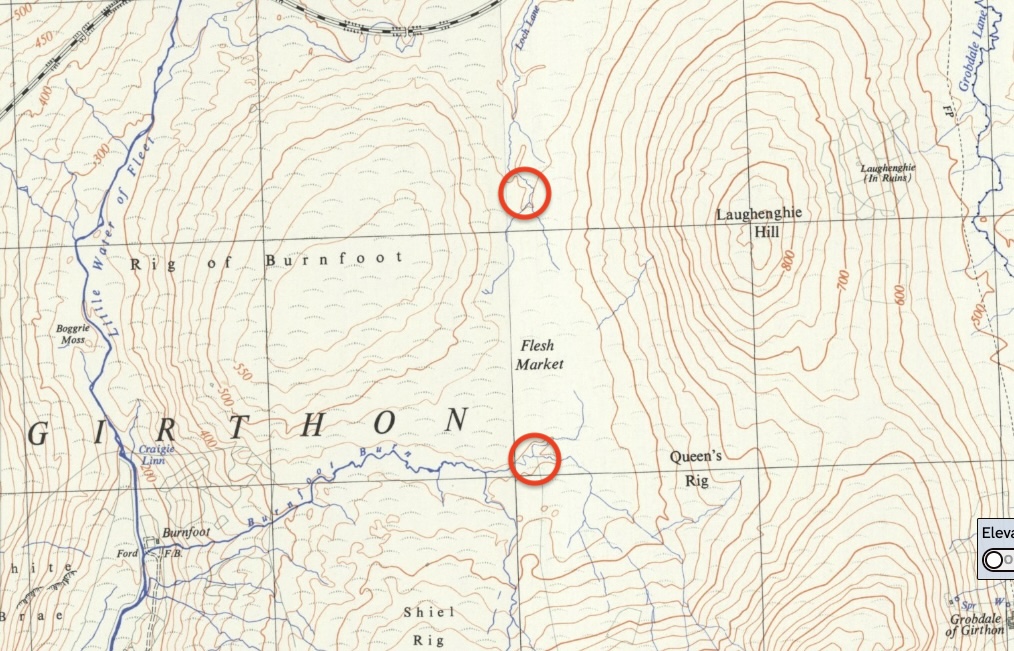
See map added at end of blog in Notes – OS 1945-1961. FC boundary was drawn from end of a fence to the south (red circle) straight up across Flesh Market to confluence of burns to north (red circle). That was a conscious decision at time of 1965 sale when agents would have known that Flesh Market had not been sold to Grobdale.
Fascinating …. highlighting the mess that Scotland and ‘her’ land are in..not helped by a SG fast asleep on the job. Would they take a quid fur it dae yer think? Scottish pound of course….
For OUR Scotland and her weans
I had a look on satellite view on Google maps but that wasn’t clear enough, just a dark patch. Made me think there is a vegetation difference on that patch called Flesh Market. What3Words satellite view is better though, and one square smack bang in the middle has the w3w address of overpaid.human.ballpoint !! 😂
Looks like a swap to create a line of convenience: you have that bit, we’ll take this bit, as a straight line fence cheaper and easier to build.
Gentleman’s agreement?
However, worth checking the history, as might have been some appropriation of common land?
Another fascinating account from Andy Wightman on the gaps in landownership records in Scotland.
Would a question from a member of the public (me) to their MSP induce more engagement from the land Registry? And if there was a number of subscribers to the Wightman website who were prepared on this and other occasion to sign of a joint request for clarifications would that help? Holding SG and its agencies to account IS important.
I think the answer is fairly straightforward. Murray Usher is the owner of the fleshmarket and may not even be aware. It is up to them to apply for land registration although the Keeper could in certain circumstances undertake it but it is unlikely that this case qualifies for Keeper induced registration. I blogged about it as it is just one example of land left over or “slivers” that will have to be dealt with one day.