Who Owns Castle Tioram?
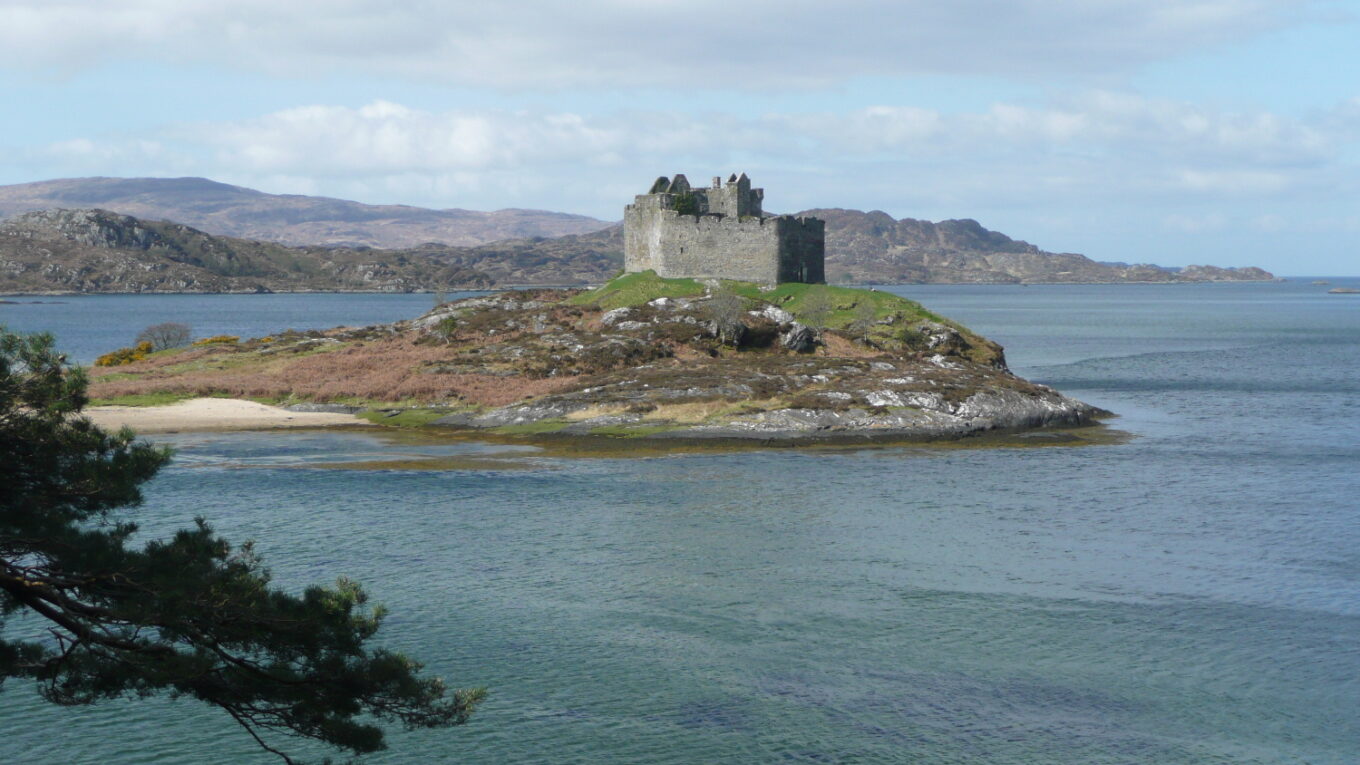
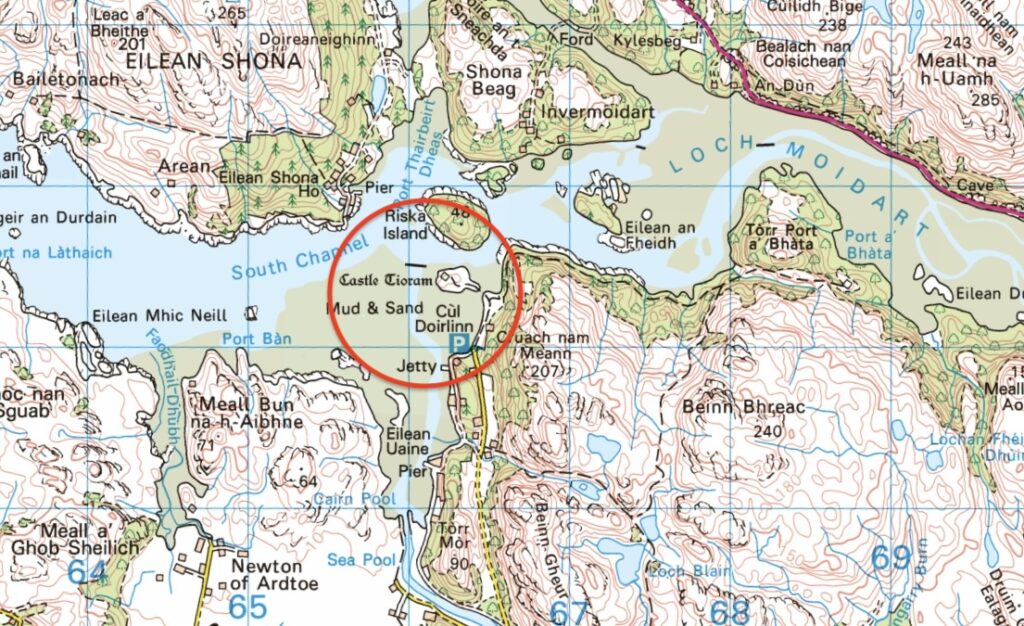
Castle Tioram is located on the tidal island of Eilean Tioram located near the mouth of the River Shiel in Loch Moidart (see map below).
The castle was granted to Clan Macdonald of Clanranald by Robert II in 1371 as part of the wider lands of Eigg, Rum, Uist, Harris, Sunart and Lochaber. It was occupied by Government forces in 1692 but recaptured by Clanranald following the Jacobite rising of 1715 following which he torched it leaving it in the ruinous state that it remains today. Useful historical information can be found here from the Moidart Local History Group.
Allan Macdonald, Chief of Clanranald sold the island in 1905 to the owner of Lochshiel Estate, Francis Fitzalan Howard, Baron Howard of Glossop. In 1926 the island was then sold to James Wiseman Macdonald from Los Angeles.
In 1997, Castle Tioram was put up for sale by the grandchildren of Wiseman Macdonald.
The Caisteal Tioram Trust (a charity representing environmental and community interests) attempted to purchase it. It was outbid, howeve,r and the castle and island were sold for £306,678 to Anta Estates Limited, a company registered at PO Box 556, Main Street, Charlestown, Nevis, West Indies.
There followed a protracted effort to secure planning consent to convert the ruined castle into a residential home. Highland Council granted consent but Historic Scotland refused Scheduled Monument consent, a decision that was upheld at a local public inquiry in 2001 and which led to much debate (see for example this article by Muriel Gray).
The person behind Anta Estates Limited appeared to be an Alexander (Lex) Brown although reports suggested that the Canadian millionaire Bronson Conrad provided the finance for the redevelopment. In an interview in the Herald in 2004, Brown claimed that it was a unnamed non-UK benefactor who had provided the funds.
On the ownership of Anta Estates Limited, he claimed that a charitable body called Highland Stronghold Trust owned the company. But in the same interview said that “the ownership is 100% mine”.
In a study by ARP Lorimer and Associates submitted to Highland Council as part of the planning application, it was claimed that Anta Estates Limited was wholly owned by the Highland Stronghold Trust.
There is no record in any UK registry of a charitable body called the Highland Stronghold Trust and the Nevis and Kitts Registry publishes no details of such trusts.
The Government of Kitts and Nevis also publishes no details about the ownership of companies such as Anta Estates Limited. So who does own the company?
The one and only deed recorded after the sale to Anta in 1997 offers a clue.
On 5 November 2004, Ranald Alexander Macdonald of Clanranald granted “for the grace, favour and affection which I have and hold for my lovite, Alexander Daniel Brown” the feudal barony of Castle Tioram and appointed Mr Brown the Castellan and Keeper of Castle Tioram.
Feudal baronies were a heritable position or dignity connected to a parcel of land. They were abolished by section 63 of the Abolition of Feudal Tenure etc. (Scotland) Act 2000 which came into full force on 28 November 2004, some two weeks after the barony was conveyed to Lex Brown.
It is important to note that a feudal barony had to be attached to land and since the Barony was of Castle Tioram and the island of Riskay (but Riskay was explicitly excluded from the sale of the land on which Castle Tiroam sits), it can be assumed that Riskay was conveyed as part of the conveyance of the Barony (see description below). [1]
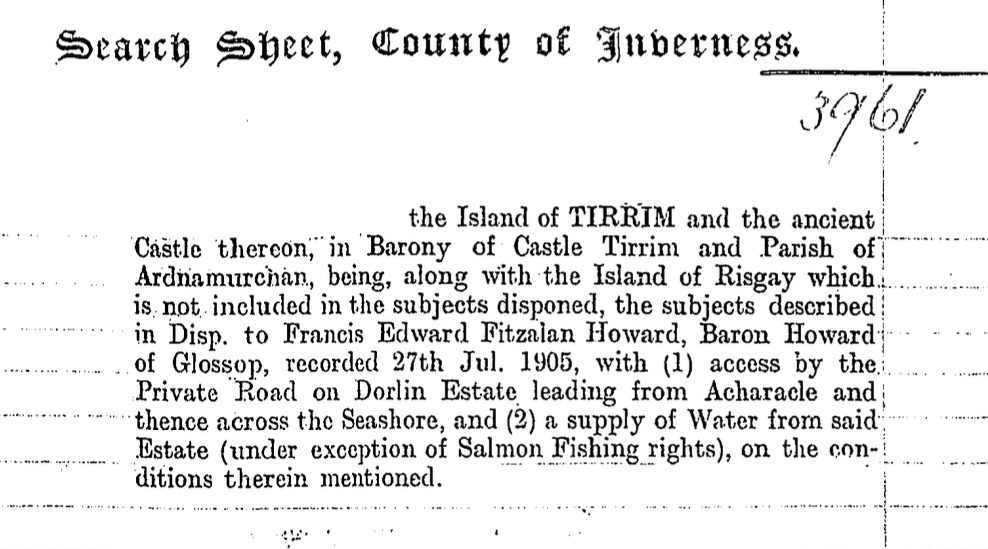
However, a note was appended to the recording of the deed as follows,
Note – Agents states that title to the subjects is held by Anta Estates Limited which is a company owned by the Granter of this Disp., wishes deed recorded as stands.
It is not clear that Anta Estates ever owned the feudal barony nor that Clanranald ever owned or had any interest in Anta Estates Limited.
This note is, to say the least, odd.
Nevertheless, there are no subsequent deeds recorded in the Register of Sasines to indicate any further transfer of ownership.
Without registration, there is no ownership. [2]
Thus Anta Estates Limited remained the owner after November 2004.
If Clanranald was the owner of Anta Estates Limited, then he must have acquired ownership of the Nevis and Kitts company sometime between 1997 and 2004. This claim conflicts with various press reports after November 2004 that Lex Brown still owned Castle Tioram (see for example, here and here in 2011).
However, according to records in the ICIJ Offshore Leaks Database (the Panama Papers), Anta Estates Limited was incorporated on 20 August 1997 (Anta acquired Castle Tioram in September 1997). The company was then closed on 1 September 2008 and struck off on 1 September 2010.
Lex Brown died in February 2022.
Assuming this is correct and setting aside the odd agent’s note in 2004 (solicitors do have a professional duty of care to the Keeper), then Anta Estates Limited no longer owns Castle Tioram since the company no longer exists.
In such circumstances, land and property fall to the Crown as bona vacantia (ownerless property). Such property is administered by the King’s and Lord Treasurer’s Remembrancer in the Crown Office in Edinburgh.
The process of alerting them to potential ownerless property involves completing a form which requires the submission of title deeds, a legal report, a property plan, a plans report, a property enquiry certificate, a community interest search report, and photographs of the property. The cost of obtaining such documentation will run into the hundreds of pounds – costs which I am not willing to incur.
I have therefore written to them asking whether, in the circumstances, they still wish to be notified.
I have included links below to the 1997 and 2004 deeds together with the Castle Tioram Search Sheet so as to enable any legally qualified readers of this blog to examine the evidence for themselves and confirm whether or not my analysis above is correct or not. Matters are, of course, complicated by the imability to examine the Kitts and Nevis Registry. Anta Estates Limited is not registered in the Register of Controlled Persons in Land.
NOTES
[1] For a fuller background to barony titles, see here.
[2] See Section 50 of the Land Registration (Scotland) Act 2012. I have tried to contact Ronald Macdonald of Clanranald but have been unsuccessful. I would be interested to know if (1) he does (or did) own Anta Estates Limited and (b) whether Anta Estates has in fact been dissolved.
REFERENCES
1997 disposition to Anta Estates Limited (9.1Mb pdf)
2004 transfer of Barony title (1.1Mb pdf)
Thank you to those who donated to enable me to acquire (for £63.60) the relevant legal documents necessary to write this account.
Nothing to do with Lachlan Stewart’s Anta, is it? They have interests in castles and restoration/conversion, but can’t see why they should be registered abroad.
Well it is a different company so I guess no ….
Dear God.
No words. Don’t let the Clanranalds get their hands on it. Horrors. This should be taken into the care of the NTS or such.
Castle Tioram is shown in a lovely Aerial screensaver/walllpaper for Macs and Apple TV; Vimeo preview here https://vimeo.com/657386068
Reminds me how, about ten years ago , I was a victim of an odd piece of poor conveyancing of an area of land between Lower Burnmouth (in Berwickshire) and the clifftop there; a company had bought and registered title to this land, using an out of date map which included my garden ground. The company was struck off and, as you describe, the ‘ownership’ accordingly passed to the Crown. I needed to get a new registered title, and I must say we found the QLTR very reasonable to deal with, and we did so without much trouble or expense.
But that was land I occupied, and had an old Sasines title for. I wonder how Tioram might be dealt with. For better or worse, no longer possible to simply record an ‘a non domino’ disposition as would once have been the possible solution.
The way I read the history is that Clanranald conveyed the castle and the neighbouring island of Riska to Lord Howard, owner of the adjacent Dorlin Estate in 1905. In 1926, his successor, Sir Alexander Maguire, sold the castle, but not Riska, to Wiseman MacDonald. In 1997, his grandchildren sold it to Anta Estates. If that company has been dissolved, then is it not a possibility that the castle now belongs to whoever is the receiver of assets of dissolved St. Kitts & Nevis companies according to the law of St K & N?
The 2004 disposition of the barony of Castle Tirrim to Lex Brown is a red herring, I think. This disp is not inconsistent with the disp of the castle to Anta Estates. They are of different things. The castle (and Riska) did not form part of the barony in 2004, having been detached therefrom in 1905 when Clanranald sold them to Lord Howard. In 2004, all that was left of the barony after the Clanranalds had previously sold most of it off was the superiorities of the six early 18th century feus mentioned in the 2004 disp. Prior to feudal abolition, a barony title could attach to superiorities. So Brown acquired these from Clanranald so he could have a barony title to go along with his (Anta’s, strictly) castle.
I don’t think much should be read into Clanranald appointing Brown as keeper of the castle in the 2004 disp which seems to imply Clanranald still owned it. I think this is just a bit feudo-pseudo-baronial play acting dreamt up to gratify people who like that sort of thing safe in the knowledge it’s legally meaningless. Maybe Romilly Squire (the witness to the 2004 disp) and George Way of Plean (who I suspect drew up the disp as the warrant is signed by his firm Beveridge & Kellas), the high priests of baronial guff and who were obviously acting for Brown, thought of it as Clanranald sort of retrospectively sticking in a kind of ‘take care of my castle!’ sort of clause that might have gone into the 1905 disp of it to Lord Howard had anyone thought or cared about that kind of thing in these days.
As regards the note on the search sheet, I think ‘granter’ is just a mistake for ‘grantee’ which makes it make sense (even though the subjects of search (the barony) are not actually the ‘subjects held by Anta Estates’ (the castle). I could imagine the clerk at Register House not quite grasping the arcane distinction. Nor caring.)
TL/DR – I think the castle belongs to the receiver of assets of dissolved St Kitts & Nevis companies, whoever that is according to St K & N law. (That is unless someone else has been in possession of the castle for at least the last ten years upon a recorded disp which for some reason has not made its way onto these two search sheets.)
I am sure you are correct “ I think the castle belongs to the receiver of assets of dissolved St Kitts & Nevis companies, whoever that is according to St K & N law”.
Would be interesting to look into that!
Brilliant piece of research.
Once again Scotland’s lands seem to be owned by mythological people..or hidden groups..or just anybody that is not Scottish because as we know our land is just for investment purposes by mainly foreign entities and I include so called ‘scottish’ aristocrats who speak with foreign english tongue let alone a forked one.Once again I ask..where is the Scottish Government when it comes to ownership of our land…Largest land owner ..Danish…..43% of our land owned by foreigners and I include foreign english in this…The SNP government seem incapable of getting independence for our country and protecting our lands from those who would use it for their own purposes..and not for the benefit of Scotland.As an old Chinese guy said..your land is your treasure ..protect it…anybody listening apart from our land warrior Andy?
Thank you for your meticulous research, we are very fortunate you are willing to take on these issues. Castle Tioram is indeed a magical place. I hope you get the answers you want.
Thanks!
There are some comments saying that the assets of a dissolved company registered in St Kitts and Nevis fall to the government there. That is the case with disposable assets, but it’s different for land. Ownerless land situated in Scotland falls to the KLTR wherever the company was registered.
Before notifying the KLTR it is worth considering if there’s an appropriate community body willing to take on ownership under the OPTS for £1 plus costs. As soon as KLTR is notified the clock is ticking on that opportunity, with a tight timetable, unlikely to be acheivable by a community group from a standing start.
The KLTR would be likely to dispose of it by auction in due course. Better if possible (in my opinion) to consider potential community ownership through OPTS before notifying them.
What would happen to a company registered in Scotland that was struck off and owned land in eg Kitts and Nevis? My thinking is KLTR would not take ownership because bona vacantia is a function of the Crown’s ultimate ownership of land in Scotland hence Castle Tioram would fall to the Crown regardless of what happens in kitts and Nevis to struck off companies there.
Totally amateur question: in legal terms, is the monarch (or crown) one person or multiple persons? Is the King of the UK of GB and NI legally the same person as the King of St Kitts and Nevis? Is the King of England the same person as the King of Scots? Is there any legal framework that can give an unambiguous answer?
The Crown is a constitutional entity – a legal person if you like. It is represented by the Monarch for the time being (Charles III)
He is also head of state of kitts and Nevis as it is a Commonwealth realm
Yes, I think that’s right, and it certainly makes logical sense.
KLTR ‘s bona vacantia policy BV2 Our Policies | KLTR https://share.google/lMhIR0ngu8HLzEThf says:
the location of the last registered office will usually determine who deals with the asset. In the case of land, jurisdiction will be determined by the country in which land is situated. In Scotland, all land falling as bona vacantia normally falls within the jurisdiction of the KLTR, regardless of where the registered office is situated.
Did the Crown’s ultimate ownership of land in Scotland survive feudal abolition, though?
yes – was preserved by s.58 of feudal abolition act https://www.legislation.gov.uk/asp/2000/5/section/58
“Ownerless land situated in Scotland falls to the KLTR wherever the company was registered” – the contra argument to that is that it’s not ownerless because its owner is whoever is the receiver in St Kitts & Nevis of property belonging to dissolved companies incorporated there. I’m not saying that’s definitely right but it’s an alternative possibility.
I am very happy to have found my way here after some difficulty. I fiund myself ‘forbidden’ to open Andy Wightman’s site at all regardless of the device or browser, but here I now am thanks to a VPN.,
.
I was the Highland Council’s Principal Archaeologist at the time of the Lex Brown purchase and application. The Council granted planning permission directly against my advice and its own policies. Because I opposed granting planning oermission, I got into a great deal of trouble from Lex Briwn’s lawyers. I applaud Historic Scotland and the Scottish Government in standing firm on the Scheduled Monument Consent despite everything Mr Brown threw at them. That Historic Scotland (now Historic Environment Scotland) now have to justify scheduling decisions in writing.is no bad thing.
As far as I, and I think my Highland Council colleagues at the time were concerned it was definiteky Lex Brown himself who bought Castle Tioram from the Wiseman Macdonald heirs. He was. In the driving seat. I understood that Anta was Mr Brown’s company. There was akready a separate company called Anta set up by Lachie Stewart, the architect who rebuilt Balloan Castle in Easter Ross. As recall, Mr Stewart was none too happy about this apparent association. One wonders why Lex Brown used the name.
Balloan Castle, is a tradition of rebuilding castles in the Highlands as houses., which Mr Brown clearly wanted to associate his project with. The most famous is orobably Eialean Donan which features on all the calendars. However this tradition takes castles that have been allowed to fall into decay and gives them a new lease of life. Castle Tioram is different because, as Andy says, it was deliberately burnt down by Clanranald to prevent it flling into government hands. It later became a curated ‘romantic ruin’ as part of. a designed lndscape. Its ruined status was and is therefore oart of its archaeological significance.
Before Lex Brown took it on, it was one of several castles included in a conservation project I unsuccessfully tried to set up. it is a fascinating place and I gave several tours of the site when it was still accessible. In fact on one occasion the then Historic Scotland Insoector and I were so absorbed in exploring the interior that the tide came in and cut us off. We were rescued by some tourists who arrived with a dinghy.
I had some dealings with the Wiseman Macdonalds, who themselves applied to convert Castle Tioram into a house and were refused planning permission. The Castle is both a Listed Building and a Scheduled Monument, and it is of very great archaeological / historical significance, not least in rekation to the Lordship of the Isles and the Jacobite risings. As I said at the time, it should have been in Guardianship. It was not long after we refused planning permission that it was acquired by Lex Brown.
I think it unlikely that Brown was acting for anyone else. He was apparently an extremely wealthy man himself. He was generally described as being in the ‘air freight’ business but it was common knowledge that he was an arms dealer; and the suspicion existed that he saw Castle Tioram as a suitably impressive but quietly out of the way location to entertain clients. Anyway, probably the less I say about this the better., but Mr Brwon was a determined and ruthless man whose ethics appeared to be questionable.
He paid Glasgow University to carry out extensive surveys of the site. These lrovided interesting archaeological information but did not alter its basic cultural significance. He also closed off the site to public access, ostensibly on safety grounds, although it seemed to me that it was reasonably safe. The Scottish Government did well to stand up for the princiiples ne lractice of the scheduling and listied building kegisaltion, but they shoukd have taken the castle into guardianship and kept it in repair rather then letting Lex Briwn sit on it for years while it deteriorated.
My involvement was a long time ago now, so it’s interesting to see how things have developed since. I imagine. Mr Brown simply lost interest and that it is now effectively owner-less. The best outcome would surely be for the Crown to take ownership, place it into state guardianship., and underwrite basic maintenance (which I do not believe would be that expensive). Ownership and management could then be granted to the Castle Tioram Trust, and it could become a major cultural nd economic asset for the local community, as it should already have been years ago.
Offshore compnies – as Andy has pointed out mny times – should not be controlling Scotland’s land nd assets at our expense. And the Crown is probably the only body that can deal with that.
In what was such a bitter and polarised debate, it is refreshing and unusual to read such a lot of sense!
The exhaustive 29(!) day Local Public Inquiry left no possible stone unturned and of the 80 or so findings not one was in Brown’s very expensive team’s favour. It was not a finely balanced argument!
Tioram is so beautiful and important that it should not be left to moulder and Yes, a form of Crown ownership and local Trust management would be a very good outcome.