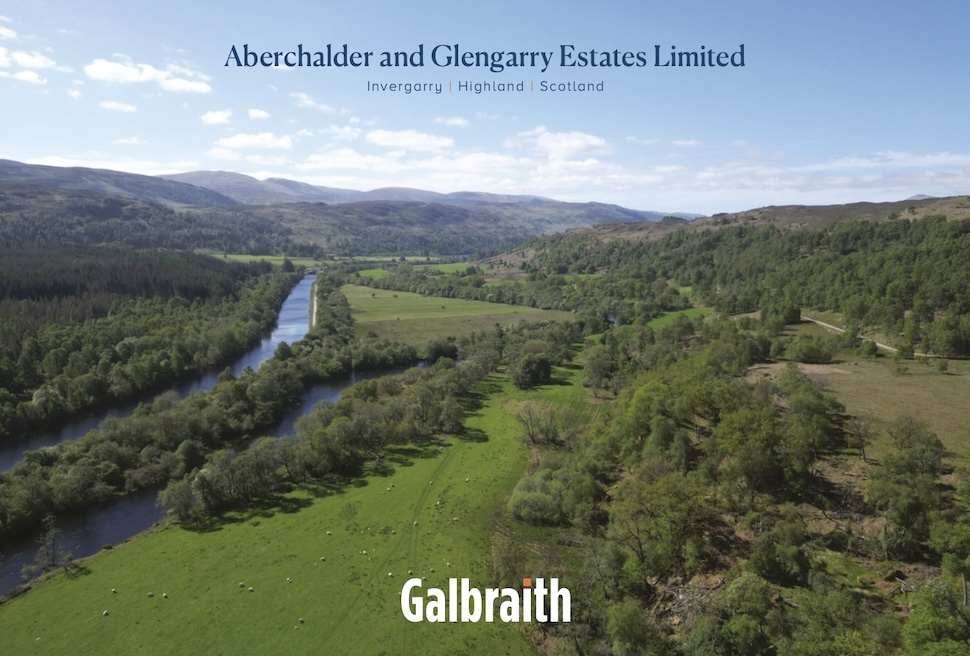
Aberchalder and Glengarry Estate Share Offer
ABERCHALDER AND GLENGARRY ESTATE IS NOT FOR SALE
Two weeks ago, the 18,748 acre Aberchalder and Glengarry estate was advertised for sale by Galbraith’s. Details are here and news release here. You can download a copy of the sales brochure here (3.9Mb pdf).
Glengarry Estate had been bought by the Ellice family in 1863 following earlier purchase of the former MacDonell of Glengarry lands of Glen Quoich in 1838. It has been owned by the Ellice family ever since.
In 1967, ownership of the estates was transferred into a Trust. In 2018 the estate was then transferred into the ownership of Aberchalder & Glengarry Estates Limited, a company controlled by the Ellice family.
The sale advertised by Galbraith’s is not of the land but of 100% of the share capital of the landowning company, Aberchalder & Glengarry Estates Limited.
This means, for example that the two agricultural tenants who hold leases over around 4400 acres of the estate are not eligible to exercise their right to buy since the land they work is not for sale.
This has a wider significance for the operation of the Land Reform (Scotland) Act 2025. When it comes into force, any sale of large landholdings (over 1000 hectares) or any part of them will have to be notified to Scottish Ministers with community bodies being given a modified form of late registration (modified from that which has existed since the Land Reform (Scotland) Act 2003) and with the land being potentially lotted by Ministers.
Of course if the land is not sold but an interest in the legal entity that owns it is, then these mechanisms will not operate. [1] Such interests include shares in UK and offshore companies, membership of Limited and Scottish Limited Partnerships and trusteeship of a Firm.
Which raises the interesting question of how much land is held by legal entities which could potentially (if the owners chose) be sold via shares or other interest? To answer this question I analysed the ownership of all the large landholdings in scope of the new legislation. The dataset I used is slightly different from that used to produce this earlier report for MSPs which identified 1054 landholdings in scope. This new analysis is based on 1109 landholdings identified my most recent Who Owns Scotland data
The extent of land (and number of owners) of each legal entity is shown in table below
| Entity | Extent (hectares) | Number |
| UK Company | 1,381,780 | 261 |
| Offshore Entities | 316,827 | 75 |
| Limited Liability Partnerships | 64101 | 19 |
| Scottish Limited Partnership | 30951 | 8 |
| Firm | 107,109 | 38 |
| TOTAL | 1,900,768 | 401 |
This analysis shows that 41% of the extent of landholdings in scope (which cover 58.8% of Scotland) could potentially “change ownership” without the title changing hands. That is 401 out of 1109 large landholdings.
There is some evidence that this is already happening. A large estate in western Scotland has been transferred within the last year from a family trust to a partnership and another was acquired by a London financial concern via the purchase of shares of an offshore company.
There are other examples including the sale of Glenkindie and Kildrummy estates which were both acquired by the purchase of shares in the Jersey based company that owned them. Earlier this year the shares in the company that owned the Tulchan Estate were sold to Tariq Ahmed Al Masaoud, an Emarati businessman and co-owner of the Al Masaood Group.
LAND REFORM CONSULTATION
One week before the Aberchalder and Glengarry Estate was marketed, Scottish Ministers launched a consultation on two aspects of the Land Reform (Scotland) Act 2025 that require to be implemented by secondary legislation.
The first is how community engagement will work in relation to the statutory management plans that will have to be prepare by landowners who own more than 1000 hectares. The second is draft guidance to help people navigate the complex rules in order to determine whether they own more than 1000 ha.
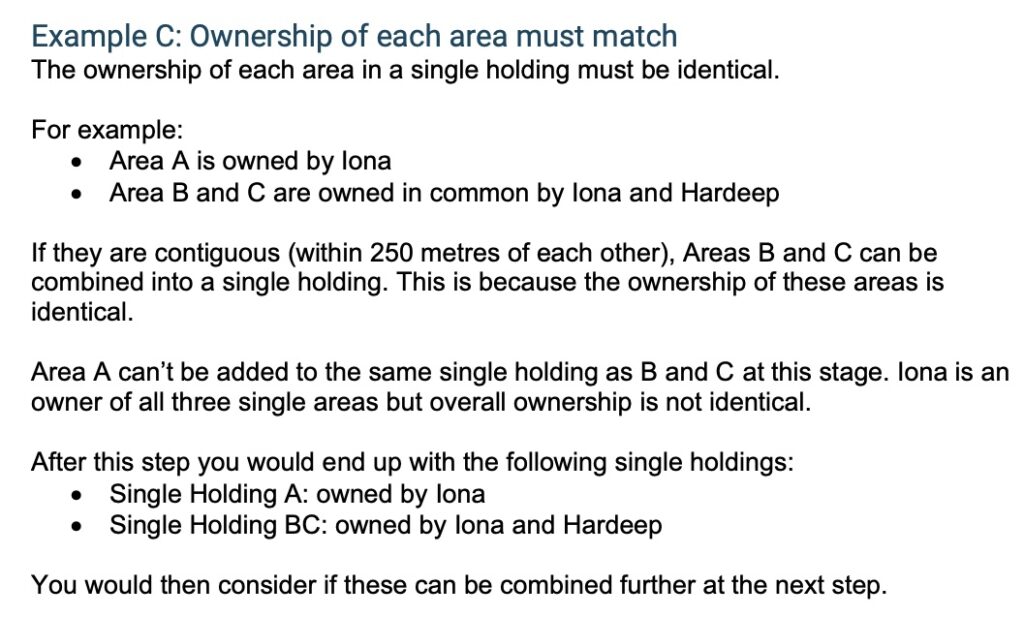
I think these rules are far too complex and in so far as they rely in part on whether someone should be registered (not actually registered) in the Register of Persons Holding a Controlled Interest in Land (RCI), I think they will prove to be unworkable.
Why so?
Because whether someone should be registered is based in part on information that is in the exclusive possession of owners and their agents and not available to you. It is impossible for anyone else to be aware that this information even exists and thus know whether in some cases a landholding is large or not.
I will set out my reasoning on this question in more detail in another blog. But as an example for now, note that, as the draft guidance admits (I think for the first time), some land is going to end up being included in different management plans because it is connected to more than one other landholding.
If I own 400 hectares but am connected (in ways I may be unaware of) to two other landowners and end up as part of two large landholdings, who is responsible for preparing the management plan and who will be liable for fines of up to £40,000 for failing to do so?
This is but one consequence of the complex way in which large landholdings are defined.
I have never regarded myself as a large landowner but, having read the draft guidance, I am not so sure.
Maybe I am.
Please do have a look at the draft guidance and if you can follow it, work out if you are the owner of a large landholding (even though you may think you only own a small house and garden).
In any event, these are both important consultations. Do consider providing feedback.
Commencement
The consultation (Annex A, page 32) sets out the outline timetable for implementation of the Act.
The Land Reform (Scotland) Bill was introduced to Parliament on 13 March 2024. It was passed by MSPs on 5 November 2025 and was enacted when Royal Assent was granted on 16 December 2025.
The Act will be commenced (start having practical legal effect) after a significant amount of secondary legislation is passed including the above. The Land and Communities Commissioner needs to be appointed (post is currently being advertised if you are interested).
Consultation on the pre-notification and transfer tests is still 2 years away in September 2028 and regulations wont be laid in Parliament until Summer 2029 with a further year before they are in force.
It will thus be Autumn 2030 before Part I of the Act comes fully into force, around five years after it was passed by Parliament. Given the current trend towards more concentrated private ownership of rural land, this legislation will struggle to have any meaningful impact any time soon.
NOTES
[1] This would apply both to the sale of the whole landholding and the sale of parts of it where the whole is transferred via the sale of interests in the legal owner and parts are transferred first of all for no consideration to such an entity and then via an interest in the entity.
It should be noted that any large landholding could potentially take advantage of this by transferring ownership from the owner (an individual) to the entities identified here for no consideration (an exempt transfer under the 2025 and 2003 Acts) and thence via an interest in the legal entity (shares, membership etc)